Sources: Bloomberg, CNBC, TechCrunch, Electrek, Teslarati, FinTech Weekly, Engadget, Benzinga, KUT Radio Austin. Event took place March 21, 2026 at the Seaholm Power Plant, Austin, Texas. All quotes directly sourced from named publications.
Table of Contents
- Light Beams Over Austin at Midnight. Texas Governor in the Crowd. No Timeline.
- What Terafab Actually Is: Two Fabs, Two Chips, One Trillion Watts
- The Supply Chain Crisis Musk Says Forced His Hand
- 80% of the Chips Are Going to Space. This Is Not a Metaphor.
- The Battery Day Problem: Why Skeptics Are Bringing Up 2020
- The Part Musk Did Not Mention on Stage: Tesla’s Sales Are in Freefall
- The Math: Current AI Compute Is 20 Gigawatts. Musk Needs 50 Times That.
- The $25 Billion That Is Not in Tesla’s Budget Yet
- Karpathy Has Not Typed a Line of Code Since December. That Is Relevant Here.
- The Honest Verdict: Insane Vision, Serious Questions, No Timeline

Light Beams Over Austin at Midnight. Texas Governor in the Crowd. No Timeline.
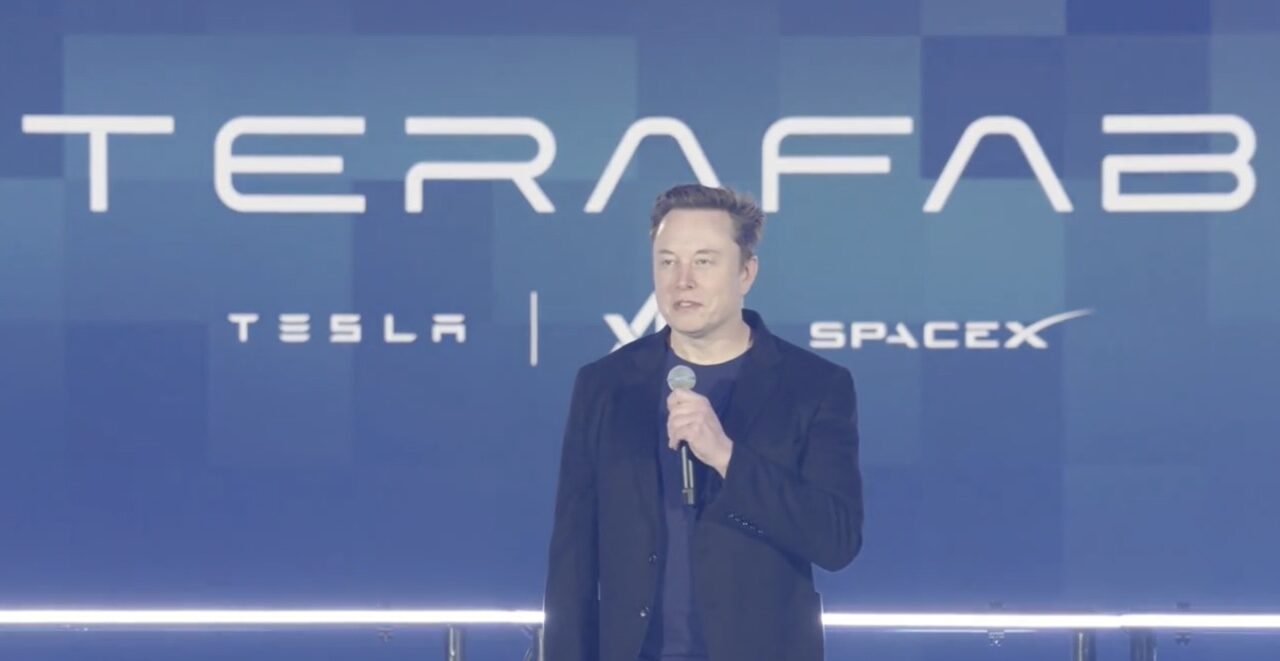
On Saturday night, March 21, Elon Musk walked onto a stage inside Austin’s defunct Seaholm Power Plant and announced what he called “the most epic chip building exercise in history by far.” Light beams shot into the Austin sky. Texas Governor Greg Abbott sat in the audience. Abbott posted on X afterward: “Thanks Elon. Extraordinary event tonight. Your vision is powerful and we are proud of all you do in Texas.”
Musk unveiled Terafab: a $20 to $25 billion joint chip manufacturing facility between Tesla, SpaceX, and xAI, to be built on the North Campus of Giga Texas in Austin. The facility would consolidate every stage of semiconductor production under one roof, chip design, lithography, fabrication, memory production, advanced packaging, and testing. At full capacity it would produce one terawatt of AI computing power per year. One terawatt. To put that in context, all current AI compute produced globally runs at roughly 20 gigawatts annually. Musk is describing a facility that would generate 50 times the entire current global AI chip output.
There was no construction timeline. No engineering specifics. No confirmation from TSMC, Samsung, or any semiconductor equipment vendor. Job postings for Terafab roles appeared on Tesla’s website during the event, listing positions in Austin and Palo Alto. Construction activity had been visible near Giga Texas in the days before the announcement. And Musk said the thing he always says when someone asks why he is attempting something nobody has done before: “We either build the Terafab or we don’t have the chips, and we need the chips, so we build the Terafab.”
What Terafab Actually Is: Two Fabs, Two Chips, One Trillion Watts
The morning after the announcement, Musk posted a clarification on X that is worth quoting directly: “Terafab will technically be two fabs, each making only one chip design.” That sentence is more specific than anything said on stage and changes the picture considerably from the initial “largest semiconductor fab ever built” framing.
Fab one produces AI5, Tesla’s fifth-generation AI inference chip designed for Tesla vehicles and the Optimus humanoid robot program. The AI5 is already in planning. Small-batch production is targeted for late 2026, with volume production projected for 2027, though it is worth noting that the AI5 was already delayed to mid-2027 before the Terafab announcement, and the AI6 chip has slipped roughly six months due to Samsung’s 2nm production schedule. Terafab is presented as the long-term solution for Tesla’s chip supply, not the near-term one.
Fab two produces the D3, a chip specifically designed for operation in space. Standard consumer and commercial chips cannot survive the radiation environment of low Earth orbit or operate reliably at the temperature extremes of a satellite. The D3 is radiation-hardened and thermally designed for orbital conditions. Musk described it as built to “take into account the harsher environment” of space. This is a chip category that essentially no civilian semiconductor company has produced at commercial scale, which is one reason the claim is both ambitious and difficult to evaluate independently.
The facility targets 2-nanometer process technology, the most advanced node currently entering commercial production at TSMC and Samsung. Producing 2nm chips without access to ASML’s extreme ultraviolet lithography equipment, which has a years-long backlog and whose export to non-allied countries is heavily restricted, is one of the fundamental infrastructure questions the announcement left unanswered. Bloomberg noted Musk has no background in semiconductor manufacturing. TechCrunch noted he “has a history of overpromising on goals and timelines.”
The confirmed facts about Terafab: Joint venture between Tesla, SpaceX, and xAI. Location: North Campus of Giga Texas, Austin. Estimated cost: $20 to $25 billion. Goal: One terawatt of computing power annually. Two chips: AI5 (vehicles and robots) and D3 (orbital satellites). Target process node: 2nm. Announced: March 21, 2026. Construction timeline: not given. Chip production timeline: small-batch AI5 production targeted late 2026. Volume production: 2027 projected. Job postings: live on Tesla’s website for Austin and Palo Alto roles.
The Supply Chain Crisis Musk Says Forced His Hand
Musk has been laying the groundwork for this announcement since at least Tesla’s Q4 2025 earnings call in January, where he told investors that external chip capacity from TSMC, Samsung, and Micron would hit a ceiling within three to four years. The framing he used at the Terafab event was generous toward his current suppliers: “We’re very grateful to our existing supply chain, to Samsung, TSMC, Micron and others,” before adding the caveat, “but there’s a maximum rate at which they’re comfortable expanding. That rate is much less than we would like.”
The chip demand driving this is not primarily about Tesla’s car business, which is discussed later in this article. It is about the scale of compute required for the Optimus humanoid robot program, for xAI’s Grok models and data center expansion, for Tesla’s Full Self-Driving training, and for the orbital satellite constellation that SpaceX filed an FCC application to launch earlier this year. That FCC filing requested a license to launch one million AI satellites into low Earth orbit. One million satellites. Each requiring compute that can operate in space. The market for radiation-hardened orbital AI processors that can support that vision does not exist yet at the required scale, which is Musk’s argument for why building it in-house is not optional.
Vertically integrating semiconductor production is the logical extension of how Musk has built his companies. Tesla makes its own battery cells, designs its own chips for FSD, builds its own manufacturing equipment when suppliers cannot meet requirements. SpaceX makes its own rocket engines, builds its own launch pads, manufactures an unusually high fraction of its own components compared to any aerospace company before it. Terafab follows that playbook into a domain where the playbook has never been applied at this scale by a non-semiconductor company.
80% of the Chips Are Going to Space. This Is Not a Metaphor.
This is the part of the Terafab announcement that gets the least coverage and deserves considerably more. Musk said 80 percent of Terafab’s compute output will be directed toward space. Not deployed in space someday. Not powering applications that eventually have space use cases. Physically placed in orbital satellites.
The reasoning he gave is specific and at least internally coherent. Solar irradiance in orbit is roughly five times greater than at Earth’s surface because there is no atmosphere, weather, or day-night cycle to manage. Thermal management in the vacuum of space, where heat radiates away freely through large panels, is more efficient per unit of area than air-cooled terrestrial data centers. Musk’s argument is that within two to three years, running AI workloads in orbit will be cheaper per unit of compute than building equivalent data centers on the ground, once you account for the free solar power and the favorable thermal environment.
SpaceX’s Starship program is the delivery mechanism. Each Starship vehicle can carry up to 150 metric tons to low Earth orbit per flight. If the launch cadence Musk has projected for 2027 and 2028 approaches anything like the targets, the physical logistics of placing significant amounts of compute hardware in orbit become plausible in a way they were not two years ago. The gap between “plausible logistics” and “working orbital data center network” is still enormous and involves solved and unsolved engineering problems in roughly equal measure. But Musk’s argument that this is where the compute goes is not purely a stage effect. It connects to a specific infrastructure plan.

The Battery Day Problem: Why Skeptics Are Bringing Up 2020
Electrek’s coverage of the Terafab announcement was the most direct in naming the historical comparison that every Tesla watcher has been thinking about: Battery Day 2020.
In September 2020, Musk stood on a stage and promised a revolution in battery manufacturing. Tesla was going to ramp the 4680 cylindrical cell to 10 GWh within a year and eventually reach 3 terawatt-hours by 2030, enough to power 20 million cars annually. The dry electrode manufacturing process was going to cut cell production costs by 50 percent. The announcement moved Tesla’s stock and generated enormous coverage about how Tesla was going to transform battery manufacturing the same way it had transformed EV manufacturing.
Five and a half years later, the 4680 program has been a significant disappointment relative to those promises. Tesla’s own top battery supplier publicly said Musk does not know how to make battery cells. The dry electrode process needed six or seven major revisions. The program took years longer than promised. The 3 TWh target by 2030 is nowhere in sight. The cells that eventually went into production work but did not achieve the cost or performance breakthrough Musk described on stage.
The pattern Electrek identified is the relevant one here. Terafab is being announced at a dramatic Austin event with light beams and a governor in the audience, with scale claims that dwarf any comparable project in the industry, targeting a technology domain where Musk and his companies have no demonstrated track record, with no construction timeline, and with the financing not yet reflected in Tesla’s stated capital expenditure plan. That is a description that fits Battery Day 2020 as well as it fits Terafab 2026. Whether the outcome is similar is unknowable from the outside. The structural parallels are visible whether you want to see them or not.
The Part Musk Did Not Mention on Stage: Tesla’s Sales Are in Freefall
There is business context for the Terafab announcement that the spectacular Austin stage show was clearly not designed to foreground. Tesla’s automotive business is in a difficult period. Sales declined for the second consecutive year in 2025. The decline in Europe has been described as a bloodbath in automotive industry coverage. 2025 marked Tesla’s first-ever annual sales decline in China. The brand has been significantly affected by the political associations that have come with Musk’s public role, and the consumer backlash has been measurable in both sales data and survey research across multiple markets.
Announcing a $25 billion joint venture with SpaceX to build the largest chip manufacturing facility in history at a dramatic midnight event with a sympathetic governor in the audience, while Giga Texas construction activity is visible from the road, is an effective way to move the conversation from declining vehicle sales to ambitious infrastructure building. Whether that is the primary motivation or simply a fortunate side effect is a question only Musk can answer. The timing is what it is.
Electrek’s framing was pointed: “This announcement is clearly designed to attach Tesla, a business in decline, and SpaceX, a business about to go public, to the AI hyperscaler narrative.” SpaceX is preparing for an IPO that could value it at approximately $1.5 to $1.75 trillion. xAI, which SpaceX acquired in an all-stock deal in February 2026, gives SpaceX direct exposure to the AI narrative. Terafab, announced by the CEO of all three companies simultaneously, connects Tesla’s manufacturing capability to SpaceX’s launch infrastructure and xAI’s AI compute demand in a way that positions all three as an integrated AI infrastructure company rather than three separate businesses with different trajectories.
The Math: Current AI Compute Is 20 Gigawatts. Musk Needs 50 Times That.
Musk said something at the event that deserves specific attention because it is either the most important context for understanding the Terafab vision or the most important evidence that the vision is detached from current reality, depending on how you weigh it.
“The current output of AI compute is roughly 20 gigawatts per year,” he said. “All of the rest of the output from Earth is about 2% of what we need.” Those two statements together say that current global AI chip production runs at 20 gigawatts annually, and that he needs 50 times that amount. Terafab’s target of one terawatt per year is exactly that: 50 times current global AI compute output, from one facility, on one campus in Austin, Texas.
TSMC, the world’s leading semiconductor foundry, produces roughly 1.4 billion chips per year across all its customers and all its products. Terafab at full capacity would match roughly 70 percent of TSMC’s entire global output. TSMC has 13 fabs, 77,000 employees, and has been building chip manufacturing expertise since 1987. No timeline was given for when Terafab would reach full capacity.
Musk’s stated vision for why this scale is necessary traces back to the Optimus humanoid robot program and the orbital satellite constellation. He has previously said Tesla expects to produce 10 billion Optimus robots eventually, with each requiring AI5-level inference chips for autonomous operation. If that timeline ever materialized, the chip demand would be unlike anything the semiconductor industry has encountered. Whether “eventually” connects to any near-term business plan is the question that separates the vision from the roadmap.
The $25 Billion That Is Not in Tesla’s Budget Yet
The most quietly significant detail from the Terafab announcement was something Tesla’s CFO confirmed at the event rather than something Musk said on stage. The $20 to $25 billion cost estimate for Terafab is not yet incorporated into Tesla’s 2026 capital expenditure plan. Tesla’s 2026 capex plan already exceeds $20 billion. Adding $20 to $25 billion for Terafab would approximately double it.
How Tesla finances this matters considerably. The company’s automotive revenue is declining. Its cash position, while substantial, is not unlimited. SpaceX is preparing for an IPO but has not yet completed it. xAI generates revenue from Grok subscriptions and API access but is not a major cash-generating business relative to the infrastructure costs being discussed. Where the capital for a $25 billion fab comes from, across three companies with different financial profiles and different investors, was not explained during the Seaholm event.
The job postings on Tesla’s website are real and specific: process engineers, equipment engineers, lithography specialists, yield engineers. These are the actual job categories required to build and operate a semiconductor fab. The postings suggest some level of organizational commitment beyond stage production. They do not tell you how far along the engineering planning is or how the project gets from hiring posts to silicon production.
Karpathy Has Not Typed a Line of Code Since December. That Is Relevant Here.
One more piece of context that connects to Terafab in a specific way: Andrej Karpathy, OpenAI co-founder and former head of AI at Tesla, revealed on the No Priors Podcast this week that he has not typed a single line of code since December 2025. “In the span of those weeks,” reporting from the CommonWealth English news digest noted, “Karpathy went from writing roughly 80% of his own code to writing almost none of it, delegating the rest to AI coding agents.”
The same week that Musk announced a $25 billion chip factory to produce more AI compute than the entire world currently generates, one of the most respected AI researchers in the industry disclosed that AI agents had already replaced him as a code writer in under three months. Those two data points, the ambition of what is being built and the pace at which existing AI capability is already changing how humans work, are the two sides of the same story about where compute actually goes if it gets built.
If Terafab delivers anything close to what Musk described, the AI agents that Karpathy and others are already using would have vastly more compute available to become vastly more capable. Whether that is a reason to build Terafab faster or a reason to think carefully about what that compute enables is a question the announcement did not engage with. Musk’s framing throughout was about building toward “a galactic civilization.” The more immediate applications of the compute he is describing were not part of the stage presentation.
The Honest Verdict: Insane Vision, Serious Questions, No Timeline
Terafab is either the beginning of the most consequential infrastructure project in the history of the semiconductor industry, or it is the most ambitious version yet of the pattern Musk has established across multiple companies of announcing things that are significantly later, smaller, or different from what was described on stage. Those two possibilities coexist right now because no construction timeline was given and no engineering partner confirmations were made.
What is not in doubt: the demand for AI compute is real and growing faster than current manufacturing capacity can satisfy. The chip supply constraint Musk described at Tesla’s earnings call is not manufactured; Nvidia’s backlogs and TSMC’s capacity constraints are well-documented across the industry. The orbital compute vision is genuinely novel and builds on SpaceX infrastructure that actually exists. The job postings are real. The construction activity near Giga Texas is visible.
What is in doubt: whether a company with no semiconductor manufacturing experience can execute a 2nm chip fab at scale, whether the financing materializes in the context of Tesla’s declining automotive revenue, whether the one terawatt target is a genuine engineering goal or a stage claim, and whether the 80 percent space allocation reflects a near-term operational plan or a long-term vision that may take a decade to realize.
The Battery Day parallel is the one Musk’s critics will keep returning to, and it is fair. Battery Day produced real cells that went into real cars, just much later and with much lower performance than promised on stage. That outcome was still meaningful progress even if it did not match the announcement. If Terafab follows the same pattern and produces real chips that go into real Tesla vehicles and real SpaceX satellites five years from now at a fraction of the stated capacity, that is still a significant outcome. It just does not look like what was announced in Austin on Saturday night with the light beams shooting into the sky.
Do you think Terafab is real in the Battery Day sense, real but delayed and scaled down, or more of a strategic announcement than an engineering commitment? Drop your take in the comments. The range of informed opinion on this one is genuinely wide and the reasoning behind each position is worth hearing.
References (March 23, 2026):
Bloomberg: “Elon Musk Plans Terafab Chip Facility in Austin, Texas With Tesla, SpaceX, xAI” (two fabs, X post quote, ASML context): bloomberg.com
CNBC: “Musk says SpaceX and Tesla to build advanced chip factories in Austin” (two fabs clarification, D3 space chip details): cnbc.com
TechCrunch: “Elon Musk unveils chip manufacturing plans for SpaceX and Tesla” (100-200 GW on Earth, 1TW in space, Bloomberg context): techcrunch.com
Electrek: “Tesla and SpaceX announce $25B Terafab chip factory, here’s why it reeks of desperation” (Battery Day comparison, Tesla sales decline, CFO budget confirmation): electrek.co
Teslarati: “Elon Musk launches TERAFAB: The $25B Tesla-SpaceXAI chip factory that will rewire the AI industry” (orbital data center rationale, solar irradiance argument, FCC filing): teslarati.com
FinTech Weekly: “TERAFAB Launched. Here Is What Elon Musk Actually Built.” (two chip types, 80/20 space/earth split, AI5 timeline, D3 specification): fintechweekly.com
KUT Radio Austin: “Elon Musk announces chip manufacturing project in Austin” (event details, Governor Abbott quote, job postings): kut.org
CommonWealth English / No Priors Podcast: Andrej Karpathy has not typed a line of code since December 2025 (March 23, 2026)
Light beams shot into the Austin sky. The governor applauded. No timeline was given.
If it works, it changes everything. Battery Day said the same thing.


Leave a Reply