Sources: Lex Fridman Podcast #494 (transcript, March 22, 2026), The Verge, Forbes, IBTimes, TheStreet, Yahoo Finance, Mashable, YouMind analysis, Phemex, Blockchain Council, WSJ (Trump tech council), Reuters (OpenAI/Microsoft AGI clause). All quotes from named publications and original transcript.
Table of Contents
- Four Words That Got 4.7 Million Views in 48 Hours
- What Huang Actually Said vs What the Headlines Said
- The Caveat He Buried Right After: “The Odds Are Zero Percent”
- The AGI Definition War: Why This Word Now Has Legal Consequences
- He Used OpenClaw as His Proof. That Is Either Brilliant or Terrifying.
- Sam Altman Said the Same Thing in February. Quietly.
- The Microsoft Clause Nobody Wants to Talk About
- The Week He Also Got Appointed to Run America’s AI Policy
- What Markets Did When He Said It
- What This Actually Means, Honestly
Four Words That Got 4.7 Million Views in 48 Hours
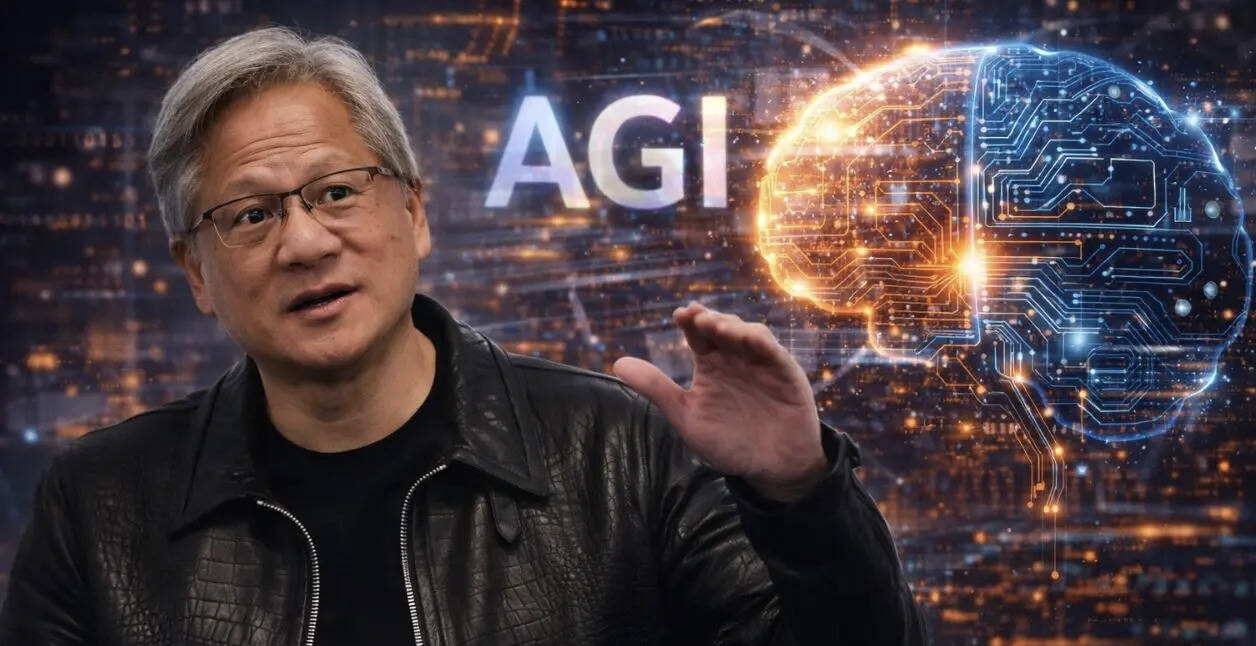
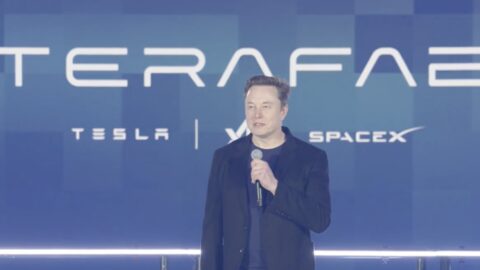
On Sunday night, March 22, Lex Fridman published episode 494 of his podcast. The guest was Jensen Huang, CEO of Nvidia, the man who runs the $4 trillion company whose chips power essentially every significant AI system on the planet. It is a long interview covering chip design, extreme co-design architecture, the Vera Rubin GPU platform, and the future of robotics.
One moment traveled at a completely different speed than the rest. Fridman asked Huang a specific question: how long before AI could autonomously start, grow, and run a billion-dollar company? Five years? Ten? Twenty? Huang’s answer took three seconds. “I think it’s now. I think we’ve achieved AGI.”
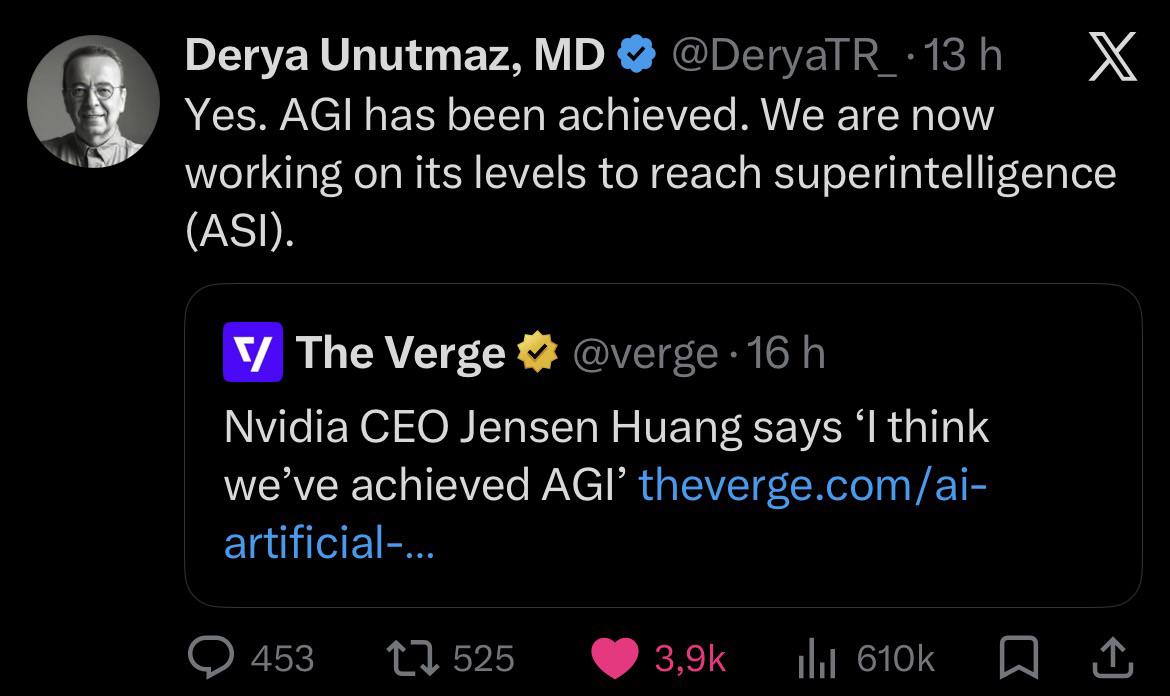
A Polymarket tweet sharing the clip crossed 4.7 million views in 48 hours. The Verge, Forbes, IBTimes, TheStreet, and Mashable all had stories up within hours. Nvidia stock rose 1.7 percent. AI-linked cryptocurrency tokens rallied between 10 and 20 percent. The phrase “Jensen Huang AGI” was trending in multiple countries by Monday morning.
This happened the same week Trump announced plans to appoint Huang to a 24-member AI policy tech council alongside Mark Zuckerberg and Larry Ellison, co-chaired by AI czar David Sacks. The man who just declared AGI achieved is also now helping set the rules for how America governs it.
What Huang Actually Said vs What the Headlines Said
The full context of the statement matters considerably more than the four words do, and Huang’s answer is more interesting than the headlines it generated when you read it completely.
Fridman had been specific about what he meant by AGI. His benchmark was not sci-fi general intelligence, not a system that passes philosophy exams or feels emotions. He asked whether an AI system could do what human entrepreneurs do: identify an opportunity, build a product, find customers, and run a company worth more than a billion dollars. That framing, economic outcome generation at scale, was what Huang responded to when he said the era is now.
He elaborated with a specific example. “I wouldn’t be surprised if some social thing happened or somebody created a digital influencer” through AI tools. He continued: “It is not out of the question that a Claude model was able to create a web service, some interesting little app that all of a sudden, you know, a few billion people used for 50 cents, and then it went out of business again shortly after.” His analogy was to the dot-com era, where brief viral websites created and destroyed enormous value in short windows. That, in Huang’s framework, already qualifies as billion-dollar company creation.
Fridman’s response to this was immediate and pointed: “You’re going to get a lot of people excited with that statement.” He was right. He was also the one who set the specific low bar, and Huang met it. Reading the transcript, the exchange looks less like an unguarded bombshell and more like two people agreeing on a narrow definition and then declaring it achieved under that definition. The gap between the headline and the actual exchange is significant.
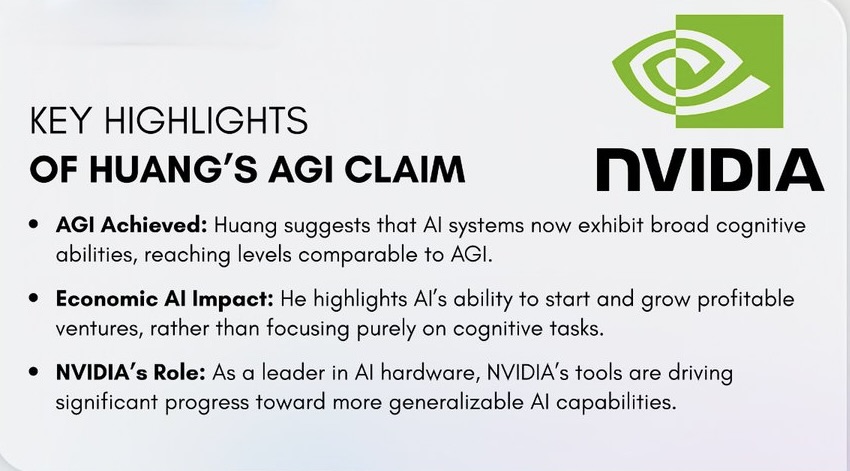
What Huang’s AGI definition includes and excludes, from the transcript:
Includes: An AI agent autonomously creating a billion-dollar app or service, even briefly, even if it fails afterward.
Excludes: Building and sustaining a complex institution over decades. Running a company like Nvidia.
His direct quote on that exclusion: “The odds of 100,000 of those agents building Nvidia is zero percent.”
The classical AI research definition he is not claiming: AI that matches or surpasses human performance across all cognitive tasks.
Nvidia’s market cap at time of statement: approximately $4 trillion.
The Caveat He Buried Right After: “The Odds Are Zero Percent”
This is the sentence that most coverage of the Huang AGI claim glossed over, and it is the most important one he said in the entire exchange.
Fridman pushed back and asked whether AI could actually build and run a company of Nvidia’s scale and complexity. A company that requires sustained long-term strategy, cross-domain coordination, physical hardware, manufacturing relationships, thousands of specialized engineers, and institutional knowledge built over 30 years. Huang’s answer was unambiguous: “The odds of 100,000 of those agents building Nvidia is zero percent.”
He was not hedging. He was drawing a clear line between what he was claiming and what he was not. AI can create a viral app that briefly generates a billion dollars in value. AI cannot build or sustain what he himself built. Those are categorically different things, and Huang knows it because he spent three decades building the second kind.
The implication is that Huang redefined AGI specifically to the narrow case where current AI already qualifies, while explicitly excluding the broader case where it clearly does not. YouMind’s analysis captured this precisely: “Every ‘AGI achieved’ declaration is accompanied by a quiet downgrade of the definition.” The downgrade in this case was baked into Fridman’s question before Huang even answered. Huang’s “achievement” is real under the specific definition used. It is not the achievement most people picture when they hear the word AGI.
The AGI Definition War: Why This Word Now Has Legal Consequences
The reason the AGI definition debate is more than a philosophical argument about terminology is that the word “AGI” now appears in legally binding contracts with specific trigger clauses that change what major companies are entitled to do and own.
OpenAI’s founding charter defines AGI as “highly autonomous systems that outperform humans at most economically valuable work.” That definition is categorically different from “an AI that could briefly run a billion-dollar viral app.” It is also the definition that triggers specific provisions in OpenAI’s agreement with Microsoft. According to Reuters reporting, when AGI is officially deemed achieved, Microsoft’s access rights to OpenAI’s technology change significantly. Microsoft currently holds a 27 percent stake and certain technology usage rights until 2032. The AGI trigger clause, which requires verification by an independent panel of experts, is the mechanism that potentially alters those rights.
Huang is not a party to that contract. His declaration on a podcast has no legal bearing on OpenAI’s obligations to Microsoft. But the fact that the word carries contractual weight at the world’s most valuable AI company explains why everyone in the industry now uses it carefully, defines it explicitly when they invoke it, and why declarations like Huang’s generate immediate scrutiny rather than simple acceptance.
TheStreet’s analysis noted the strategic dimension of Huang’s claim directly: “Nvidia controls the infrastructure that makes any definition of AGI commercially viable. That is exactly the kind of narrative leverage that has made this stock so difficult to bet against.” A CEO of a chip company declaring that the technology his chips enable has crossed a major intelligence threshold is not a neutral observation. It is, at minimum, also a business statement about the continued necessity of those chips.
He Used OpenClaw as His Proof. That Is Either Brilliant or Terrifying.
Huang’s concrete example of AGI achieved was OpenClaw, the open-source AI agent framework that became the fastest-growing project in GitHub history and was covered in CyberDevHub’s earlier article this month. He described a scenario where an AI using OpenClaw-style architecture creates a viral web service, generates billions of transactions at 50 cents each, and then goes out of business once the novelty wears off. In his framework, that sequence qualifies as AGI.
The choice of OpenClaw as the reference point is interesting for multiple reasons. OpenClaw is a real, existing system. It is already running. It has two million weekly active users. It was literally cited in this example of “AGI already achieved” by the CEO of the company that makes the chips it runs on.
It is also the system that, according to Bitdefender’s security analysis, had 824 malicious skills in its marketplace, 512 total documented vulnerabilities, a CVSS 8.8 remote code execution vulnerability, a Meta security researcher who had to physically unplug her computer to stop it from deleting her emails, and a Microsoft advisory saying not to run it on your work computer. The specific system Huang cited as evidence that AGI has arrived was simultaneously being described as “the creepiest app on your phone” and a significant enterprise security liability by major security institutions.
That juxtaposition is either a perfect illustration of where AI actually is in 2026, powerful enough to qualify as AGI under one definition, dangerous enough to require physical intervention to stop under another, or it is an indication that the definition being used for “AGI” has more than a little flexibility built into it.
Sam Altman Said the Same Thing in February. Quietly.
Huang is not the first person to make this declaration in 2026. In February, Sam Altman told Forbes: “We basically have built AGI, or very close to it.” He immediately qualified it as a “spiritual” statement rather than a literal one, adding that AGI still requires “many medium-sized breakthroughs.” The qualifier softened the landing enough that it did not generate the same market reaction as Huang’s unqualified four words.
The pattern YouMind identified across multiple AI leaders is consistent: declaration followed by immediate definitional retreat. Altman said “basically built AGI” and then said it is spiritual and requires more breakthroughs. Huang said “we’ve achieved AGI” and then said the odds of 100,000 agents building Nvidia are zero. Both are saying something real about the current state of AI capability. Both are also saying something that sounds more definitive than the follow-up qualifiers support.
The difference in how the two statements landed is partly the medium. A Forbes interview with careful follow-up questions produces a more nuanced statement. A Lex Fridman podcast exchange produces a clippable moment. The four-word clip of Huang traveled at podcast-clip speed, which is much faster than the nuance speed of the surrounding context.
The Microsoft Clause Nobody Wants to Talk About
While Huang’s statement has no direct legal implications, it lands against a backdrop where the AGI question is not purely philosophical for the industry’s most important commercial relationship.
OpenAI and Microsoft renegotiated their partnership agreement in late 2025. The new structure, as reported by Reuters, includes an independent expert panel that would need to verify AGI achievement before specific contract provisions trigger. Microsoft retains a 27 percent stake and technology usage rights through 2032. What those rights look like after a verified AGI declaration is the clause both companies have strong incentives to think carefully about.
OpenAI has not declared AGI under its own charter’s definition. Its charter requires “highly autonomous systems that outperform humans at most economically valuable work,” a much higher bar than Fridman’s billion-dollar company benchmark. Altman’s February “basically built AGI” statement was explicitly not an official declaration under the charter’s terms. These distinctions matter because the people responsible for triggering a legal provision worth billions of dollars in Microsoft stock and technology rights are being careful about exactly where they draw the line.
Huang, who is not party to this agreement, can use the word freely and redefine it however serves the conversation. He did. The contrast between how carefully OpenAI uses the word and how casually Huang deployed it reflects two very different relationships to the word’s consequences.
The Week He Also Got Appointed to Run America’s AI Policy
The AGI declaration did not happen in a vacuum. The same week the Lex Fridman episode published, the Wall Street Journal reported that President Trump plans to appoint Huang to a 24-member AI policy technology council. The council will be co-chaired by David Sacks, Trump’s AI and crypto czar. Other reported appointees include Mark Zuckerberg and Larry Ellison.
The composition of that council and what it will actually do have not been fully detailed in public reporting. But the basic structure is notable: the three people with the most to gain financially from favorable AI regulation, Huang whose chips are the infrastructure of AI, Zuckerberg whose platforms are the distribution layer, and Ellison whose Oracle Cloud is a major AI infrastructure customer, are being placed in advisory roles on AI policy for the US government in the same week one of them declared AGI achieved.
This is not a conflict of interest allegation. Advisory councils routinely include major industry figures. It is an observation about the timing and the composition. The man who just said AI has reached general intelligence is now helping advise the government on how to regulate the technology he just declared generally intelligent. Whether you find that reassuring or concerning probably depends on how you weighed his definition of AGI in the first place.
What Markets Did When He Said It
The market reaction was immediate and specific. Nvidia shares rose 1.7 percent in the days following the podcast release. That is a modest move for a $4 trillion company where 1.7 percent represents roughly $68 billion in market capitalization. The move was attributed in analyst commentary specifically to the AGI declaration reinforcing the narrative that demand for Nvidia’s chips will remain strong indefinitely as AI capabilities continue to scale.
AI-linked cryptocurrency tokens moved more dramatically. Multiple tokens with direct AI associations rallied between 10 and 20 percent in the 48 hours after the clip circulated. Crypto markets, which are more volatile and more narrative-driven than equity markets, responded to the AGI declaration as a bullish signal for AI infrastructure broadly.
The inverse happened for some competitors. If AGI under the economic benchmark definition is already here, the urgency for every company to continue scaling AI investment becomes more rather than less intense. That narrative supports chip demand, cloud infrastructure demand, and AI platform spending simultaneously. A CEO of the world’s dominant AI chip company declaring that the technology has crossed a major threshold is, as TheStreet noted, “exactly the kind of narrative leverage that has made this stock so difficult to bet against.”
What This Actually Means, Honestly
Huang said something true and something misleading in the same breath, and separating them is the useful exercise.
The true part: AI systems in 2026, using frameworks like the ones Huang described, can take autonomous actions that generate real economic value at significant scale. OpenClaw agents can build and run apps. Coding agents write production code that ships to millions of users. AI systems handle customer service, content moderation, data analysis, and dozens of other economically valuable tasks with minimal human oversight. By the specific narrow benchmark Fridman posed, some version of a claim that AI is already operating at a level that can generate billion-dollar outcomes is defensible.
The misleading part: calling that “AGI” using the four letters that the research community, the policy community, and most people who followed this technology for years associate with human-level general intelligence is a deliberate redefinition, not a neutral description. Huang knows this. He admitted it in the same breath by saying the odds of those same systems building Nvidia are zero. A system that can generate a viral app but cannot build or sustain a complex institution over decades is impressive. It is not what most people picture when they hear the word general.
The reason this matters beyond semantics is that the word carries weight. It shapes investment decisions. It influences policy conversations. It affects how non-expert people understand the technology and what risks they think it does or does not present. When the CEO of the world’s most valuable chip company says AGI is here, in the same week he is appointed to advise the US government on AI policy, the definition he is using is not a footnote. It is the whole story.
What Huang actually described is genuinely impressive and genuinely consequential. Whether it is AGI depends entirely on what you think that word means, and that question now has legal, financial, and policy implications that make it considerably more than an academic debate. The four words traveled at the speed of a viral clip. The context is traveling at the speed of a careful reading. One of those speeds is winning.
Do you think AGI has been achieved under any reasonable definition, or is this goalpost-moving dressed up in a declaration? Drop your take in the comments. The range of serious positions on this question is genuinely wide and the reasoning matters more than which side you land on.
References (March 25, 2026):
Lex Fridman Podcast #494, Jensen Huang transcript (March 22, 2026): lexfridman.com/jensen-huang-transcript
IBTimes: “Nvidia CEO Jensen Huang Declares ‘We Have Achieved AGI,’ Sparking Debate Over Definition”: ibtimes.com
TheStreet: “Nvidia CEO Jensen Huang says we have achieved AGI” (legal/strategic analysis, NVDA stock reaction): thestreet.com via aol.com
Yahoo Finance: “Nvidia CEO Jensen Huang claims AGI has been ‘achieved,’ can create billion-dollar businesses” (Fridman Q&A context, investor skepticism): finance.yahoo.com
YouMind: “NVIDIA CEO Jensen Huang Announces AGI Has Been Achieved: Full Breakdown” (zero percent quote, definition shifting pattern, Altman February quote, OpenAI/Microsoft clause): youmind.com
Digit.in: “Jensen Huang says ‘AGI is now’: Truth behind viral clip explained” (Polymarket 4.7M views, crypto rally 10-20%): digit.in
Phemex: “Jensen Huang Declares AGI Arrival: Full Breakdown” (market impact, crypto reaction, NVIDIA stock 1.7%): phemex.com
Wall Street Journal: Trump to appoint Huang, Zuckerberg, Ellison to 24-member AI tech council co-chaired by David Sacks (March 25, 2026)
Reuters: OpenAI/Microsoft AGI trigger clause, independent expert panel verification requirement, 27% stake and 2032 rights
The CEO of the world’s most valuable chip company said AGI is here.
Then he said the odds of those same systems building his company are zero percent.
Both sentences are true. Only one of them made headlines.



Leave a Reply