
Table of Contents
- Before You Buy Anything: Three Questions That Filter Out 80% of the Hype
- Samsung Galaxy S26 Ultra: The Best Android Phone You Can Buy Right Now
- Honor Robot Phone: The Weirdest Gadget at MWC 2026 That Actually Makes Sense
- Honor MagicPad 4: The Thinnest Android Tablet Ever Built
- Apple MacBook Air M5: The Laptop That Most People Should Just Buy
- Apple iPad Air M4: A Modest Upgrade That Is Still the Best Mid-Range Tablet
- GPD Win 5: The Handheld Gaming PC That Does Not Apologize for Being Ambitious
- AI Meeting Pins in 2026: Genuinely Useful or Still a $700 Gimmick?
- Smart Glasses Finally Got Good: What to Know Before You Buy
- What to Actually Buy, Based on Who You Are

Before You Buy Anything: Three Questions That Filter Out 80% of the Hype
Gadget releases in 2026 have a specific problem. Every product launched this year claims to have AI. Smart scales, kitchen timers, Bluetooth speakers, phone cases with chips in them: the word AI is on the box regardless of whether there is anything genuinely intelligent happening inside. Filtering useful from marketing requires asking a few specific questions before you spend money.
The first question is whether the AI processing is local or cloud-dependent. Local processing, where the AI runs directly on a chip inside the device, is faster, works offline, and does not send your data to a third-party server. Cloud-dependent AI requires an internet connection for every feature and often requires a monthly subscription. Many AI gadgets that seem impressively capable in a demo fall apart when you check whether the monthly fee turns off after the trial period. Always check what the product does without a subscription before buying it.
The second question is whether your phone could already do this. A large fraction of the AI gadgets launched in 2026 replicate things a flagship smartphone already does, just in a different physical form. That is not always a bad thing, wearable form factors have real advantages for specific use cases, but it is a reason to be specific about what you actually need. An AI meeting recorder is genuinely useful if you are in back-to-back meetings with your phone in your pocket. It is not useful if you are already propping your phone on the desk and using a free transcription app.
The third question is what happens to the device in two years. AI hardware is moving fast enough that products from 2024 already feel dated. If a gadget requires server-side AI that the company is running at a loss and can switch off, the device becomes a paperweight when the company runs out of funding or changes direction. Local processing products have longer useful lives because the intelligence lives in the hardware you own, not in a server you are renting.
With those filters in mind, here is an honest rundown of the best gadgets of 2026 that are actually worth your time and money.
Samsung Galaxy S26 Ultra: The Best Android Phone You Can Buy Right Now
Samsung launched the Galaxy S26 Ultra at MWC 2026 in Barcelona and Tom’s Guide called it a standout across the whole show floor. The S26 Ultra is not a radical redesign of the S25 Ultra, which is actually one of the things that makes it good. Samsung spent the last two years refining this form factor, and the S26 Ultra is the culmination of that work rather than an experiment with something new.
The headline feature that Samsung is specifically promoting is a Privacy Display mode, which limits the screen’s viewing angle so people sitting next to you on public transport cannot see what you are doing. This is more useful than it sounds for anyone who uses their phone for work emails or banking in public spaces. It is not revolutionary but it is the kind of practical feature that actually changes daily use rather than just showing up in demos.
The camera system remains one of the best on any Android phone. The built-in AI photography tools have gotten meaningfully better over the S25 generation: better subject separation for portraits, more natural sky replacement when you actually want it, and improved low-light processing that holds detail rather than painting over it with aggressive noise reduction. AI-generated image editing features are present but Samsung has done a reasonably good job of making them optional rather than automatic, which I appreciate. The phone does not constantly offer to remove people from your photos in a way that makes everything look uncanny.
The S Pen integration remains the clearest differentiator from every other Android phone on the market. If you take handwritten notes, sketch, or annotate documents regularly, nothing else at any price point offers what the S26 Ultra does. If you never use a stylus, you are paying for capability you will not touch, and the Pixel 9 Pro or the base S26 is a better value choice.
Who it is for: Android users who want the best available camera system, anyone who needs S Pen functionality, professionals who want a phone that handles both work and personal use without compromise.
Who should wait: Anyone on an S24 Ultra or S25 Ultra. The improvements are real but not large enough to justify the upgrade cost if you are already on recent Samsung hardware.
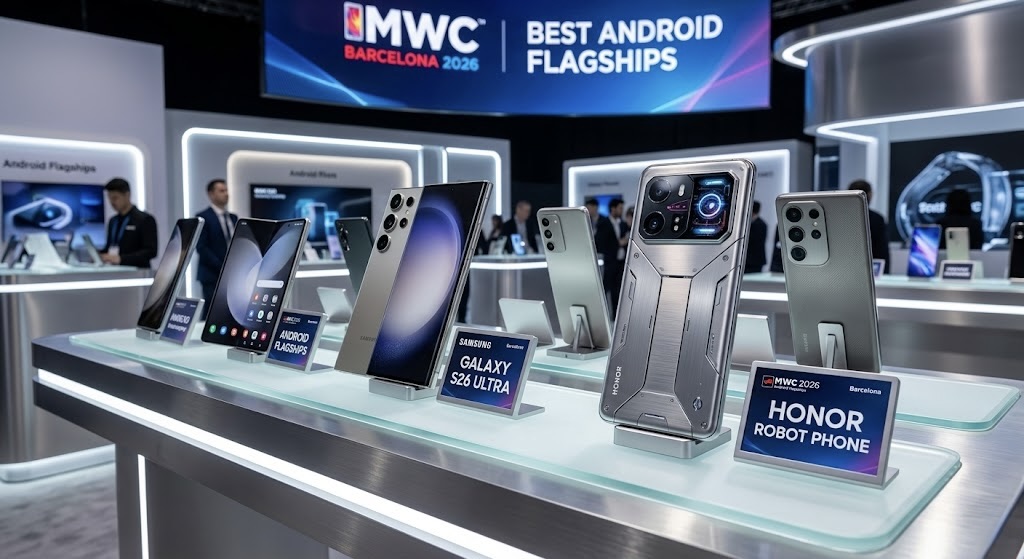
Honor Robot Phone: The Weirdest Gadget at MWC 2026 That Actually Makes Sense
The Honor Robot Phone was the most-photographed device at MWC 2026 and for understandable reasons. It has a small robotic arm extending from the back of the phone that holds the camera, allows it to swivel and track subjects, and turns the entire handset into something that looks like a miniature DJI Pocket 3 that happens to also make phone calls.
The comparison to DJI Pocket 3 is exactly the right frame for evaluating it. The robotic camera arm can follow you, track faces, hold a frame while you move, and function as a hands-free vlogging camera without requiring a separate gimbal or second device. If you create video content and you currently carry your phone plus a separate stabilizer, the Robot Phone eliminates one device entirely. That is a genuinely useful consolidation rather than a feature added for the sake of novelty.
TechRadar’s MWC coverage noted the device generated significant attention, including a comparison to having an “opinionated DJI Osmo Pocket 3 stuck to your phone.” Pricing and global availability have not been confirmed at the time of writing. Honor has not committed to a US release, and their track record on Western market availability is inconsistent.
Who it is for: Content creators, vloggers, anyone who wants gimbal-quality video from their phone without carrying separate equipment.
Who should wait: Everyone in the US, at least until availability is confirmed. Also anyone who does not create video content regularly; the robotic arm adds thickness and presumably cost for a feature you would never use.
Honor MagicPad 4: The Thinnest Android Tablet Ever Built
The MagicPad 4 measured 4.8mm thick at MWC 2026, which is thinner than Apple’s iPad Pro M5 and thinner than any other Android tablet currently on the market. Tom’s Guide called it the best Honor product at the show. For context: a standard pencil is about 7mm in diameter. This tablet is thinner than a pencil.
More importantly, the thinness is not the only feature. The 12.3-inch OLED display runs at 165Hz and has slim enough bezels to feel genuinely modern rather than just thin. The 10,100mAh battery is substantial given the form factor, the Snapdragon 8 Gen 5 chipset provides current-generation performance, and up to 512GB of storage is available. Honor also added native windowed multitasking support, which allows proper side-by-side app use in a way that Android tablets have historically handled inconsistently.
The limitation worth knowing: Honor is a Chinese brand with limited support infrastructure in Western markets. Software update support is less certain than you get from Samsung or Apple, and repair options are more constrained. If you are buying this for a two to three year relationship with the device, that matters more than if you are buying it as a secondary screen or media consumption device where the stakes of an unpatched security issue are lower.
Who it is for: Android tablet users who want the thinnest and lightest option available, anyone prioritizing OLED display quality over ecosystem integration, people who want a media tablet without paying iPad Pro prices.
Who should wait: Anyone deep in the Apple or Samsung ecosystem who will miss cross-device integration features. Anyone who needs strong long-term software support guarantees.
Apple MacBook Air M5: The Laptop That Most People Should Just Buy
Apple refreshed the MacBook Air in early 2026 with the M5 chip. The physical design is unchanged from the M4 model, which is fine because the M4 design was already excellent. The upgrade Apple made that matters most for most users is doubling the base storage from 256GB to 512GB, which addresses the most common complaint about the previous generation. At $100 more than the M4 base price was, it is a straightforward value improvement.
The M5 chip delivers improved performance and AI processing capabilities over M4. Apple’s Neural Engine handles local AI tasks like transcription, photo processing, and the on-device features in Apple Intelligence. The N1 wireless networking chip is included, which Gear Patrol noted provides noticeably better Wi-Fi performance particularly in crowded environments. The included power adapter has been upgraded to 40 watts, which means the MacBook Air now charges meaningfully faster out of the box without requiring a separately purchased charger.
The MacBook Air is the best laptop recommendation for most people at most price points because of how few compromises it requires. It is thin and light. It has all-day battery life that actually means all day. The display is excellent for the price. The keyboard and trackpad remain the best on any laptop regardless of operating system. The M5 chip handles everything except GPU-intensive work without any perceptible struggle. For students, general professionals, content consumers, and anyone who does not need Windows or Linux for specific software, this is the correct answer.
Who it is for: Students, general-purpose users, anyone upgrading from an Intel Mac, anyone who wants a no-compromise daily driver without needing the Pro’s extra performance headroom.
Who should not buy it: Video editors, machine learning engineers, anyone running GPU-heavy workloads. The MacBook Pro M5 Pro/Max exists for those use cases and the price difference is justified by what the extra chips deliver for sustained professional workloads.
Quick comparison: MacBook Air M5 vs MacBook Pro M5
MacBook Air M5 starts at $1,099 (512GB base storage, M5 chip, no fan). Best for: students, general use, portable work.
MacBook Pro M5 Pro starts at $1,999 (M5 Pro chip, active cooling, better sustained performance). Best for: developers, video editors, ML work, anyone running heavy workloads for extended periods.
The fanless Air throttles under sustained load. The Pro does not. If you run things that genuinely stress the CPU for more than a few minutes, the Pro is worth the price difference. If you do not, the Air is the right choice.
Apple iPad Air M4: A Modest Upgrade That Is Still the Best Mid-Range Tablet
Apple’s 2026 iPad Air brings the M4 chip to both the 11-inch and 13-inch models. The performance improvement over M3 is real but modest: Apple claims up to 30 percent faster processing. The bigger practical upgrades are the RAM increase, the N1 wireless chip for improved Wi-Fi, and the C1X cellular modem for cellular models. The design is identical to the previous generation. The price is unchanged.
The iPad Air M4 occupies the specific market position of being the best tablet for people who want Apple’s ecosystem at a price below the iPad Pro. It runs every iPad app, works with Apple Intelligence features, supports the second-generation Apple Pencil, and pairs with the Magic Keyboard for laptop-adjacent productivity. For students specifically, the combination of M4 performance, the Pencil for handwritten notes, and the full iPadOS productivity suite is genuinely hard to compete with at the price point.
One thing the iPad Air does not do is justify buying an iPad Air M3 right now. If you already have an M3 model, the M4 upgrade is not large enough to warrant the cost. If you are buying new, the M4 is the obvious choice since it is the same price as the M3 was at launch.
Who it is for: Students, general tablet users, people who want Apple Pencil support without Pro prices, anyone entering the iPad ecosystem for the first time.
Who should consider alternatives: Power users who need the iPad Pro’s Thunderbolt connectivity, better display, and higher performance ceiling. Also anyone who rarely uses a stylus and would be happy with the base iPad at a lower price point.
GPD Win 5: The Handheld Gaming PC That Does Not Apologize for Being Ambitious
The GPD Win 5 was picked by Yanko Design as one of the five best gadgets of March 2026, described as a device that “refuses to apologize for its ambition.” GPD makes handheld Windows gaming PCs and the Win 5 is their current flagship: a full Windows 11 device small enough to hold in your hands, with game controller buttons built into the sides, running actual PC games rather than mobile ports.
The concept is not new. The Steam Deck proved the market for handheld PC gaming exists at mainstream scale. What GPD builds is the enthusiast tier of that market: smaller, more portable, and running a full Windows environment rather than SteamOS, which means it runs any Windows game without compatibility concerns and can also serve as a genuine portable workstation for developers or professionals who want to travel light without leaving their full toolkit behind.
The trade-offs are real. The screen is smaller than a Steam Deck. Battery life on full PC hardware in a handheld form factor is shorter than on a dedicated gaming handheld with optimized hardware. The price is higher than a Steam Deck. And Windows on a small screen with controller input is not always elegant, particularly for navigating the Windows desktop or system settings. GPD has added software layers to make this more manageable but it is still more friction than SteamOS delivers.
For the specific use case of a developer or power user who wants to play their Steam library and do real computing from a device that fits in a jacket pocket, the Win 5 is arguably the only product that addresses it. For people who primarily want to play games, the Steam Deck OLED at half the price is a better choice.
Who it is for: Developers, IT professionals, and power users who want a portable workstation that doubles as a gaming device. Enthusiasts who specifically need Windows compatibility for their game library.
Who should buy a Steam Deck instead: Anyone who primarily wants to play games and does not need the Windows environment for professional purposes.
AI Meeting Pins in 2026: Genuinely Useful or Still a $700 Gimmick?
The AI pin category, small wearable devices that clip to clothing and use AI to record, transcribe, and summarize conversations, had a rough start in 2024 when Humane’s AI Pin was criticized heavily and the company was eventually acquired. The category has not died. It has gotten more practical and considerably cheaper.
The current generation of AI meeting pins, from Plaud and similar manufacturers, has largely abandoned the “replace your smartphone” ambition that made the first-generation products seem absurd. They do one thing: record audio, transcribe it with speaker identification, and give you a clean summary with action items. That is a genuinely useful task, particularly for professionals who attend meetings constantly and spend significant time afterwards trying to reconstruct what was discussed and what they committed to.
The local processing question matters enormously for this category. Pins that send all audio to the cloud for transcription are a privacy concern in any meeting that involves anything sensitive, which in professional contexts is almost every meeting. Pins with on-device processing or end-to-end encrypted transcription handle this differently. Plaud’s approach uses encrypted cloud processing but allows you to review and delete transcripts. Check this carefully for whatever product you are evaluating, because the data handling policies vary significantly across manufacturers.
The subscription trap is also present in this category. Most AI pins have a hardware cost plus a monthly fee for the AI transcription service. The math works if you use it regularly. It does not work if you buy it, use it enthusiastically for three weeks, and then stop carrying it. Be honest with yourself about your meeting frequency and note-taking discipline before spending money here.
Who should buy an AI pin: Professionals in meetings four or more hours per day who currently struggle with note-taking and follow-up action tracking. Anyone who has genuinely tried phone-based transcription apps and found the form factor inconvenient.
Who should not: Students, casual users, anyone who primarily works alone or in small groups where a phone on the desk handles this adequately already.
Smart Glasses Finally Got Good: What to Know Before You Buy
Smart glasses have been almost good enough since Google Glass in 2013. In 2026 they are finally actually good enough for daily wear, with the caveat that what they are good for is still specific rather than general.
The Even Realities G2 and similar second-generation AR glasses from several manufacturers provide a heads-up display overlay for text, navigation, and notifications without looking like a piece of medical equipment. TechRadar’s MWC 2026 coverage noted these glasses “share a lot of similar features” and manage to keep “things far more refined” than earlier generations. They do not try to overlay a full augmented reality environment on the world, which was always the ambition that made earlier smart glasses impractical. They do a more modest thing well: they put information in your peripheral vision without requiring you to look at your phone.
Meta’s Ray-Ban collaboration has proven the consumer appetite for smart glasses that look normal exists. The current Meta Ray-Bans are primarily audio, AI assistant, and camera glasses rather than display glasses. Their value is in the form factor: you can take phone calls, listen to music, and ask questions of an AI assistant without anything in your ears or your hands. For an active lifestyle where earbuds are uncomfortable or inconvenient, they solve a real problem.
The camera-in-glasses privacy concern is real and worth acknowledging. Wearing glasses that record video is a capability that creates social friction in some contexts. Every current smart glasses product with cameras requires either disclosure or removal in environments where recording is inappropriate. This is not a reason not to buy them but it is a genuine consideration about when you will and will not wear them.
Who should buy smart glasses: Active users who want audio and AI assistant access without earbuds, early adopters comfortable with some social friction, cyclists and runners who want navigation without looking at a phone.
Who should wait: Anyone expecting the full AR overlay experience that was promised in earlier generations. The display-based smart glasses that exist in 2026 are useful but limited. The genuinely immersive AR glasses that justify replacing everyday eyewear are probably two to three years away from being practical for most people.
What to Actually Buy, Based on Who You Are
Rather than a ranked list where everything gets a score out of ten, here is what to buy based on what you actually need in 2026.
You are a student who needs a laptop for the next four years: MacBook Air M5. No other laptop at this price offers comparable battery life, performance, and build quality for general academic use. If you are studying computer science or need Windows for specific software, the Lenovo ThinkPad or Dell XPS range are the strongest alternatives.
You need a new phone and are on Android: Samsung Galaxy S26 Ultra if you want the best available camera and S Pen. Pixel 9 Pro if you want the best pure software experience and timely updates. Honor Robot Phone if you are a content creator and it becomes available in your market with confirmed software support.
You want a tablet mostly for consuming content and light note-taking: iPad Air M4 if you are in or want to be in the Apple ecosystem. Honor MagicPad 4 if you want Android and the thinnest possible device. Samsung Galaxy Tab S9 FE or similar if you want a value option that does not compromise on screen quality.
You play PC games and want to do it on the go: Steam Deck OLED for most people. GPD Win 5 if you specifically need Windows compatibility and are comfortable paying the premium.
You attend lots of meetings and are drowning in follow-up tasks: Try a free transcription app on your phone for two weeks first. If you are actually using it and the form factor bothers you, then look at AI pins. If the free app satisfies the need, skip the hardware purchase.
The honest summary of gadgets in March 2026 is that the best ones are the ones doing familiar things significantly better rather than the ones introducing entirely new categories. The MacBook Air M5 is a better MacBook Air. The Galaxy S26 Ultra is a better Galaxy Ultra. The Honor MagicPad 4 is the thinnest tablet anyone has shipped. The most interesting genuinely new thing is the Honor Robot Phone, which has not been to market long enough for anyone to know if the execution matches the concept. The products that were already good have gotten better. That is not exciting but it is useful.
What are you currently using and what specifically bothers you about it? Drop it in the comments and I will tell you whether an upgrade is actually worth it or whether the money is better spent on something else entirely.
References (March 2026):
Tom’s Guide MWC 2026 Best in Show Awards (Galaxy S26 Ultra, Honor MagicPad 4, Honor Robot Phone): tomsguide.com
TechRadar MWC 2026 Day 1 coverage (smart glasses, Honor Robot Phone): techradar.com
Gear Patrol Best New Gadgets 2026 (MacBook Air M5, iPad Air M4, Sonos Play, GPD Win 5): gearpatrol.com
Yanko Design 5 Best Tech Gadgets of March 2026 (GPD Win 5): yankodesign.com
Apple MacBook Air M5 specifications: apple.com
Apple iPad Air M4 specifications and pricing: apple.com
Honor MagicPad 4 specs (4.8mm thickness, 12.3-inch OLED, 10,100mAh): Tom’s Guide MWC coverage
Medium: “10 Best AI Gadgets of 2026: My Honest Review” (AI pin buying criteria framework): medium.com/@ayeshha2398
The best gadget of 2026 is not the flashiest thing announced at a trade show.
It is the one you will still be using and appreciating in two years.

Leave a Reply