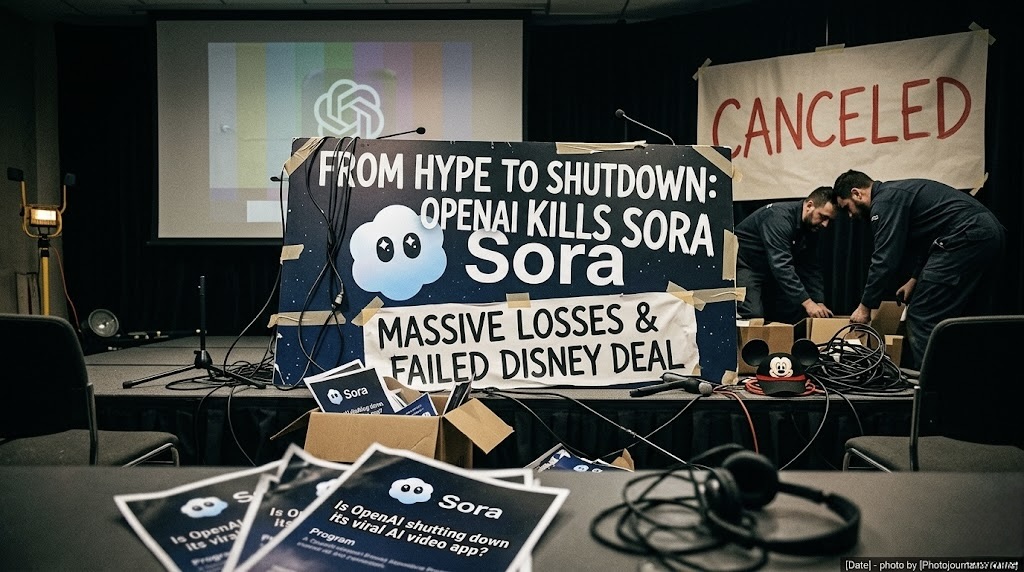
Sources: Bloomberg (Rachel Metz, March 24), CNN, NBC News, TechCrunch, Variety, Forbes, Appfigures (download data), KeyBanc Capital Markets analyst note, OpenAI official X post. All figures from named publications and market intelligence firms. Story broke March 24, 2026.
Table of Contents
- $15 Million a Day to Run It. $2.1 Million in Total Revenue. The Math Was Never Going to Work.
- What Sora Was Actually Supposed to Be
- TechCrunch Called It “The Creepiest App on Your Phone.” They Were Not Wrong.
- The Numbers That Explain Everything: 3.3 Million Downloads, Then 66% Gone
- The $1 Billion Disney Deal That Evaporated the Same Day
- The Time Another Company Named Cameo Sued OpenAI Over the Word “Cameo” and Won
- What OpenAI Actually Said vs What It Meant
- The IPO Shadow: Why Burning $15 Million a Day Becomes a Problem When Investors Are Watching
- The Sora 2 Model Is Not Dead. Just Locked Behind a Paywall.
- What Sora’s Collapse Actually Tells You About AI in 2026
$15 Million a Day to Run It. $2.1 Million in Total Revenue. The Math Was Never Going to Work.
On Tuesday, March 24, 2026, the official Sora account posted on X: “We’re saying goodbye to Sora. To everyone who created with Sora, shared it, and built community around it: thank you. What you made with Sora mattered, and we know this news is disappointing.”
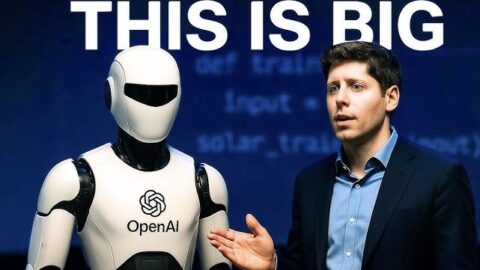
Within hours, Bloomberg, CNN, NBC News, and Variety had confirmed what the vague farewell post only implied: OpenAI is killing Sora completely. The app, the website, the developer API, all of it. Six months after it launched to the top of the iOS App Store. Three months after Disney announced a $1 billion partnership built around it. And at the exact moment OpenAI is preparing for an IPO that could value the company at over $300 billion.
The reason, dressed up in official language about “focusing compute” and “world simulation research,” comes down to a number that Bill Peebles, OpenAI’s own head of Sora, posted on social media with striking candor: the economics are “completely unsustainable.” Forbes estimated OpenAI was spending approximately $15 million per day on inference costs at Sora’s peak. Appfigures, the mobile intelligence firm, tracked the app’s total lifetime revenue from in-app purchases: $2.1 million. Not per day. Total. Across its entire existence. The gap between what it cost to run and what users paid for it was not a business problem. It was a mathematical impossibility dressed up as a product.
What Sora Was Actually Supposed to Be
The original Sora demo in February 2024 was genuinely impressive. OpenAI released a research preview showing AI-generated videos of photorealistic quality: a woman walking through Tokyo streets in rain, woolly mammoths on a snowy hillside, a drone shot of a mountain canyon. The clips were stunning enough that they generated immediate comparisons to Hollywood production quality and set off a wave of coverage about the end of human filmmakers, video editors, and cinematographers.
That demo was made from cherry-picked clips generated at high compute cost specifically for the preview. It was not representative of what a consumer product at scale would deliver at accessible prices. But it set an expectation that OpenAI spent the next eighteen months trying to live up to.
The standalone Sora app launched in September 2025. The concept was essentially AI-powered TikTok: a vertical video feed populated entirely by AI-generated clips, where users could create, share, and remix content. The flagship feature, originally called “cameos,” allowed people to scan their faces and appear in any AI-generated video, a deepfake of yourself that you created on purpose. The vision was a social platform where reality and imagination were indistinguishable, where you could see yourself surfing a wave on Mars or walking through medieval Florence without leaving your couch.
It hit number one in the iOS App Store’s Photo and Video category on launch day. The hype was real. The retention was not.
The math that killed Sora:
Estimated inference cost at peak: ~$15 million per day (Forbes)
Annualized inference cost: ~$5.4 billion
Total lifetime revenue from in-app purchases: $2.1 million
Peak monthly downloads: 3.33 million (November 2025, Appfigures)
Monthly downloads by February 2026: 1.13 million (66% decline in 3 months)
ChatGPT weekly active users for comparison: 900 million
Sora team’s next project: world simulation research for robotics
TechCrunch Called It “The Creepiest App on Your Phone.” They Were Not Wrong.
The content moderation disaster at Sora deserves its own section because it was both predictable and genuinely bizarre in the specific ways it played out.
Almost immediately after launch, users discovered that the guardrails on the “cameos” feature were easily bypassed. The intended use case was people creating fun videos of themselves in fictional scenarios. The actual use case that went viral was people using it to create realistic deepfakes of other people, including celebrities, deceased figures, and OpenAI’s own executives.
Sam Altman clones became a specific genre. One widely circulated video showed an AI Altman walking through a pig slaughterhouse asking “Are my piggies enjoying their slop?” while stroking the animals. Another showed him seemingly stealing Nvidia chips. The videos were unsettling in the specific way that highly realistic AI impersonation of a real living person tends to be. Altman is a public figure who had spent years talking about the potential of AI. Watching yourself rendered as a cartoon villain by the technology you built and championed is not a brand experience most executives would choose.
More seriously, users generated realistic videos of deceased figures including Martin Luther King Jr. and Robin Williams. The families of both publicly complained. OpenAI received significant criticism for allowing this and scrambled to add additional restrictions. The whack-a-mole dynamic of content moderation on a platform designed to generate any realistic video from any prompt, with real human faces, turned out to be exactly as difficult as everyone who had thought about it for five minutes predicted it would be.
TechCrunch’s headline describing Sora as “the creepiest app on your phone” was not editorial hyperbole. It was a fair summary of the user experience that the platform’s design essentially guaranteed. When your flagship feature is realistic deepfake video of any person, you have made content moderation your primary engineering challenge. Sora never solved it.
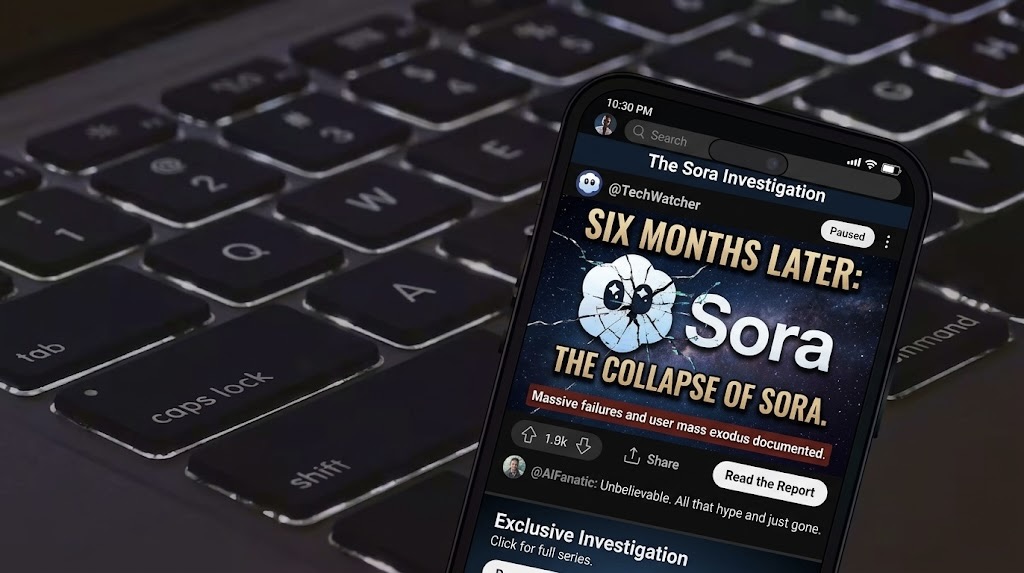
The Numbers That Explain Everything: 3.3 Million Downloads, Then 66% Gone
The download trajectory for Sora is the clearest visualization of how quickly initial hype can fail to convert into retention. Appfigures tracked monthly downloads across iOS and Google Play: 3.33 million in November 2025, the peak. Then 66 percent of that was gone by February 2026, leaving just over 1.1 million monthly downloads three months later.
For context, that February number would be a respectable performance for most apps. For an app that OpenAI positioned as the centerpiece of its consumer creative platform, backed by the brand of the company that built ChatGPT, competing directly with TikTok’s model of infinite entertaining video content, 1.1 million monthly downloads represented a failure to achieve the retention that the launch numbers had suggested was possible.
KeyBanc Capital Markets analyst Justin Patterson summarized the situation in a research note: even with all of OpenAI’s resources, Sora could not attract and retain an engaged audience. The specific failure mode was the same one that has killed most AI-generated content platforms: novelty wears off faster than capability improves. The first five AI-generated videos a user sees are fascinating. The next hundred are less interesting. The content quality ceiling that Sora could reach at prices users were willing to pay was not high enough to compete with the infinite authentic human creativity on TikTok, YouTube, and Instagram Reels.
Monthly active users peaked in December 2025 and were declining through early 2026. The app was not just failing to grow when OpenAI made the shutdown decision. It was actively shrinking. The shutdown announcement came not at the moment of failure but after the trajectory had made the endpoint clear enough that continuing to burn compute on it could no longer be justified.
The $1 Billion Disney Deal That Evaporated the Same Day
The most spectacular collateral damage from the Sora shutdown is the Disney partnership, which Variety confirmed is now dead.
In December 2025, Walt Disney Company announced a three-year licensing deal with OpenAI centered on Sora. Under the agreement, Sora would have been able to generate user-prompted videos featuring more than 200 characters from Disney, Marvel, Pixar, and Star Wars. Mickey Mouse, Cinderella, Iron Man, Buzz Lightyear, Darth Vader: the entire Disney character library available as AI video generation fodder. Disney Plus was going to add a curated selection of Sora-generated fan videos to its platform. Disney planned to take a $1 billion stake in OpenAI as part of the deal, though Bloomberg reported the investment was structured as stock warrants rather than cash.
The deal was notable for multiple reasons. Disney is famously protective of its intellectual property. The company that spent decades and hundreds of millions of dollars in legal costs defending the Mickey Mouse copyright had agreed to let an AI generate video content featuring its most valuable characters on demand from user text prompts. It was a signal that even the most traditionally IP-protective companies in entertainment had concluded that licensing into AI was preferable to fighting it.
A Disney spokesperson confirmed the partnership is over: “As the nascent AI field advances rapidly, we respect OpenAI’s decision to exit the video generation business and to shift its priorities elsewhere.” The statement is notable for what it does not say. It does not indicate anger or plans for legal action. Disney chose a graceful exit from a deal that had not yet been executed, since no money had reportedly changed hands before the shutdown announcement. The billion-dollar partnership that was going to let you generate your own Star Wars adventure video evaporated on the same Tuesday as everything else.
The Time Another Company Named Cameo Sued OpenAI Over the Word “Cameo” and Won
There is a subplot to the Sora story that is absurd enough to deserve its own paragraph. When OpenAI launched the feature that let users scan their faces to appear in AI-generated videos, they called it “cameos.” This was a problem because there is already a company called Cameo that sells personalized video messages from celebrities. Cameo, the company, took OpenAI to court over the name. Cameo, the company, prevailed. OpenAI was forced to rename the feature “characters.”
In the history of product naming conflicts, a company building potentially industry-defining AI video technology losing a trademark dispute over a feature name to a startup best known for selling Snoop Dogg birthday messages is not one that anyone had on their bingo card. It happened. The feature was renamed. The renamed feature continued to enable the deepfake content that made the app’s moderation challenges worse. And now the app, the feature, and the renamed feature are all being shut down, with the Cameo lawsuit as a footnote that will appear in the postmortem coverage for years.
What OpenAI Actually Said vs What It Meant
The official explanation from OpenAI arrived in a statement to CNN: “As we focus and compute demand grows, the Sora research team continues to focus on world simulation research to advance robotics that will help people solve real-world, physical tasks.”
Parsed carefully, this sentence is doing significant work. “As we focus” means: we are shutting things down that are not central to what we are trying to do. “Compute demand grows” means: the infrastructure we are building for our core products needs all the GPU capacity we have. “World simulation research to advance robotics” is the exit with dignity: Sora was not a failed product, it was a research project that is now being channeled into something more important.
That framing is at least partially true. The underlying technology that powered Sora, the ability to generate consistent, physics-aware video that maintains object and spatial coherence across time, is genuinely relevant to training robotic systems. A robot that needs to learn how to navigate real-world environments benefits from AI that understands how physical objects move and interact. The leap from “generate convincing AI TikToks” to “train robots to navigate kitchens” is real, even if using Sora’s shutdown as the bridge to that announcement is also convenient PR.
What OpenAI did not say: the economics were irreconcilable. The app was losing tens of millions of dollars daily. Downloads were declining. The moderation problems were ongoing. The IPO is coming. Investors evaluating OpenAI at a $300 billion-plus valuation do not want to see a product burning $5 billion annually for $2 million in revenue on the balance sheet. The robotics pivot is real. The financial pressure was also real. Both things are true simultaneously.
The IPO Shadow: Why Burning $15 Million a Day Becomes a Problem When Investors Are Watching
OpenAI’s expected IPO is the single most important financial event on the company’s near-term horizon. Bloomberg confirmed this week that OpenAI recently raised $110 billion at a valuation of approximately $730 billion, ahead of a potential public offering. At that valuation, every product decision gets scrutinized through the lens of what it says about the company’s ability to build scalable, profitable businesses rather than just impressive demos.
A product burning an estimated $15 million per day in inference costs while generating $2.1 million in total lifetime revenue is not a growth story. It is a liability. Future public market investors doing diligence on OpenAI’s product portfolio would find Sora and ask the questions that venture investors, who fund companies through product experiments, do not necessarily demand answers to. What is the path to unit economics that make sense? At what user scale does video generation become profitable? What is the retention curve and how does it improve over time?
The answers to those questions, based on the six-month trajectory of the actual product, were not good. Shutting Sora down before the IPO filing eliminates a line item that would require explanation and eliminates the ongoing cash burn that would have to be disclosed as a continuing operational expense. The timing is not incidental. OpenAI is preparing its public narrative and Sora did not fit it.
The Sora 2 Model Is Not Dead. Just Locked Behind a Paywall.
One nuance in the shutdown that matters for users who were relying on Sora for actual work: the Sora 2 model itself is not being deleted. The standalone product ecosystem is what is being retired. The iOS app, the Sora.com website, the developer API: these are all going away. But the underlying model remains accessible through ChatGPT for paying subscribers on Plus and Pro plans, at least for now.
The LaoZhang AI analysis of the shutdown was precise about this distinction: what is being eliminated is the standalone product experience. What remains is access to Sora-quality video through the ChatGPT interface, where you cannot use it programmatically through the API for your own applications but can still generate individual clips through the chat interface. For developers who had built production applications on the Sora API, that distinction matters enormously: the model survives but the programmatic access is gone.
Google Veo, which has emerged as the quality leader in AI video generation based on current benchmark rankings, is now the dominant alternative for both consumer and developer use cases. Luma AI, Runway Gen-4.5, and Kling fill different parts of the market. The AI video generation category is not disappearing with Sora. It is just going to be led by companies that either have more sustainable cost structures or have built their video generation into broader product suites where the compute cost is offset by other revenue streams.
What Sora’s Collapse Actually Tells You About AI in 2026
The Sora shutdown is the most expensive lesson in AI product economics since the early chatbot collapse of 2023. But the lesson is different from the one most coverage is drawing.
The failure was not that AI video generation does not work. The technology works impressively when you give it enough compute. The failure was that “impressive when given unlimited compute” and “viable consumer product at prices people will pay” are two completely separate questions, and Sora answered the first one without ever adequately answering the second.
Video generation is categorically more compute-intensive than text generation. Every second of output requires rendering hundreds of frames, each needing spatial and temporal consistency across the entire video. The per-token cost of generating video is orders of magnitude higher than the per-token cost of generating text. The price point at which users will pay for AI-generated video is set by their comparison to free human-generated content on TikTok and YouTube, which is essentially unlimited and does not cost anything to consume. The unit economics of AI video generation at consumer price points are not a temporary problem waiting for better hardware. They are a structural challenge that requires either dramatically lower inference costs or dramatically different pricing from what consumers expect for digital video content.
The companies that will win in AI video generation are the ones targeting professional use cases, where the value of the output justifies significantly higher per-minute pricing, or the ones who have found ways to distribute the inference cost across other revenue streams. A film studio paying hundreds of dollars per minute for AI-generated visual effects is a different market from a consumer paying $10 per month to make fun deepfakes for social media. Sora tried to serve the consumer market with economics that only make sense for the professional one.
OpenAI is an extraordinary AI research company building technology that is genuinely transforming multiple industries. That is compatible with having launched a consumer product whose unit economics never made sense at the scale required. Both things are true. The Sora shutdown is not evidence that OpenAI does not know what it is doing. It is evidence that making a convincing demo and building a sustainable business around that demo are different skills, and the AI industry is still learning which is which for each specific application category.
Did you use Sora while it was live? What did you make with it? Drop it in the comments. The gap between what people actually found useful versus what the platform was marketed as is the most interesting thing to understand about why it failed.
References (March 25, 2026):
Bloomberg: “OpenAI plans to discontinue its Sora AI video generator six months after high-profile app launch” (Rachel Metz, Disney partnership details, IPO context): bloomberg.com
TechCrunch: “OpenAI’s Sora was the creepiest app on your phone, now it’s shutting down” (moderation failures, Cameo lawsuit, deepfake details): techcrunch.com
Variety: “OpenAI Will Shut Down Sora Video App; Disney Drops Plans for $1 Billion Investment” (Disney 200+ characters deal, family complaints, Variety March 24): variety.com
CNN: “OpenAI is winding down Sora, the video generation app” (official OpenAI robotics statement): cnn.com
NBC News: “OpenAI shutting down Sora video-generating app” (IPO context, Steve Kopack): nbcnews.com
RevolutionInAI / Forbes citation: $15 million/day inference cost estimate, Bill Peebles “unsustainable economics” statement: revolutioninai.com
Deeper Insights: “OpenAI Shuts Down Sora AI: What Happened?” (Appfigures download data, $2.1M revenue, Sam Altman deepfake details): deeperinsights.com
LaoZhang AI Blog: “Sora 2 API Shutdown: Complete Guide” (Sora 2 model remains in ChatGPT, developer migration details): blog.laozhang.ai
KeyBanc Capital Markets (Justin Patterson research note on Sora retention failure): cited in multiple financial coverage outlets
$15 million a day to run it. $2.1 million in total revenue. Six months. One $1 billion Disney deal collapsed.
Sam Altman deepfakes walking through pig slaughterhouses. The math was never going to work.



Leave a Reply