Sources: The Hacker News, Fortune, Engadget, Newsweek, Proton Blog, Help Net Security, Platformer (Casey Newton), TechPP, State of Surveillance. Story confirmed from Meta’s official Help Center page. Events effective May 8, 2026.
Table of Contents
- The Notice Meta Buried on a Support Page Nobody Reads
- What End-to-End Encryption Actually Does and Why Losing It Matters
- The “Low Adoption” Excuse Is Hard to Take Seriously
- After May 8: What Meta Can Do With Your DMs That It Cannot Do Right Now
- The Take It Down Act: Why the Timing Is Not a Coincidence
- TikTok Made the Same Call the Same Week
- What Zuckerberg Said in 2019 and What He Is Doing in 2026
- Who Gets Hurt Most When Instagram Loses Encryption
- What You Should Do Before May 8
- The Bigger Pattern This Is Part Of
The Notice Meta Buried on a Support Page Nobody Reads
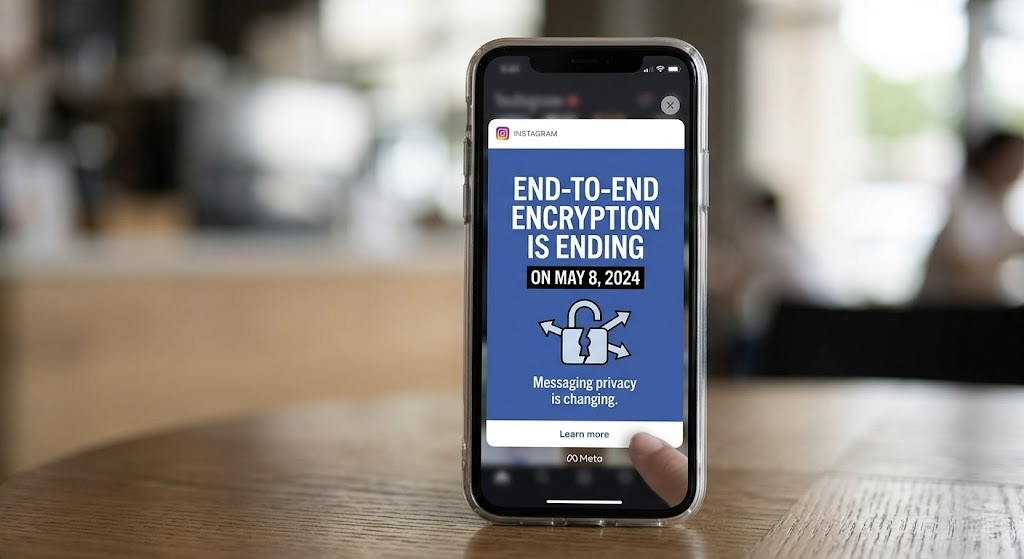
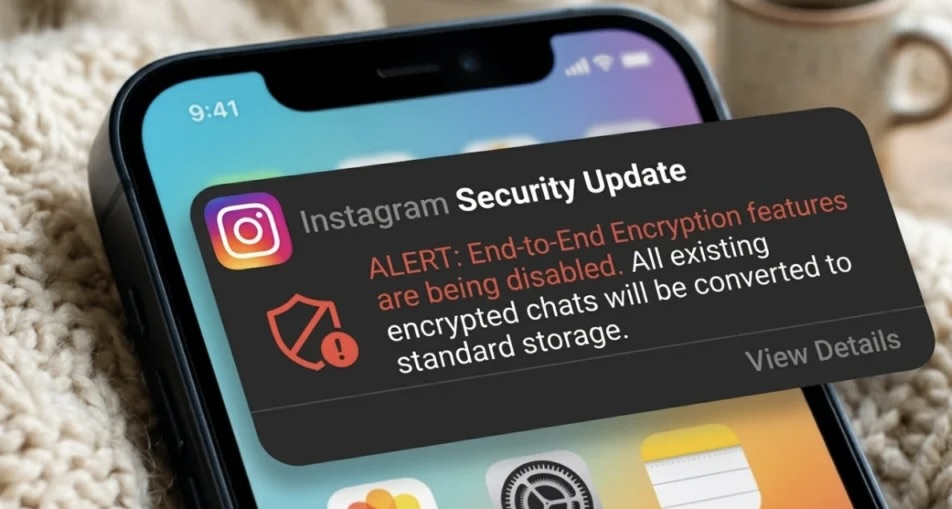
Meta did not send a push notification. It did not post an announcement. It did not email users. It updated a support page on Instagram’s Help Center with a single sentence: “End-to-end encrypted messaging on Instagram will no longer be supported after May 8, 2026.” That was it. The news only reached a wider audience after journalist Casey Newton noticed the change and posted about it on social media, at which point Meta sent a formal statement to reporters.
The statement Meta gave was this: “Very few people were opting in to end-to-end encrypted messaging in DMs, so we’re removing this option from Instagram in the coming months. Anyone who wants to keep messaging with end-to-end encryption can easily do that on WhatsApp.”
Both the way this was announced and the explanation for why it is happening deserve more scrutiny than they have received in most coverage. This article is going to give them that scrutiny, because the practical consequences for the people who use Instagram to have private conversations are significant enough to be worth understanding before May 8 arrives.
What End-to-End Encryption Actually Does and Why Losing It Matters
End-to-end encryption, E2EE, means that messages are encrypted on the sender’s device and can only be decrypted by the recipient’s device. Nobody in the middle can read them. Not hackers intercepting traffic on a public WiFi network. Not government agencies with subpoenas. Not Instagram’s own servers. Not Meta. The message leaves your device locked, travels across the internet locked, and arrives at the other device where only the recipient’s key can open it.
When E2EE is in place, a court order demanding message content from Meta produces nothing useful. Meta does not have the content because Meta cannot see the content. When it is not in place, those same messages are stored on Meta’s servers in a form the company can access, read, scan, and hand over in response to legal requests.
The difference is not theoretical. Meta previously emphasized that “no one can read your messages or hear your calls except the people who have these special keys, not even Meta.” With the feature’s removal, those protections will no longer apply to Instagram direct messages after the May 2026 deadline. What was a private channel between two people becomes a channel that Meta can observe, scan for content, and share with third parties under the company’s terms of service and applicable law.
For most Instagram users who are chatting about weekend plans or sharing memes, this change has minimal practical impact on their daily experience. For a specific set of users, the impact is not minimal at all.
The “Low Adoption” Excuse Is Hard to Take Seriously
Meta’s stated reason for removing E2EE is that not enough people used it. This explanation has a specific problem that Platformer’s Casey Newton identified in his reporting: Meta never gave most users a chance to adopt it. Even those who got access found that the feature was hidden behind four taps and never advertised within the app itself.
Think about what that means. Meta introduced an optional privacy feature, made it available only to users in some areas rather than everyone, hid it behind multiple settings menus, never promoted it to users or mentioned it in the app’s primary interface, and then removed it citing low adoption. That is not a straightforward account of user behavior. It is a description of a feature that was set up to fail from the beginning.
The statement says the feature is being deprecated because not enough people used it, that the whole situation is somehow users’ fault. And where once Zuckerberg argued persuasively that encrypted communications should be the default, the company now writes about “anyone who wants to keep messaging with end-to-end encryption” as if they should be considered a fringe group.
Instagram first began testing E2EE for DMs in 2021. It never finished rolling it out to all users. As of earlier this year, some users, including the journalist who broke the story, still did not have access to the feature on their own accounts. The opt-in design, limited rollout, and buried settings menu are the reasons adoption was low, and the company citing low adoption to justify removal is circular in a way worth naming directly.
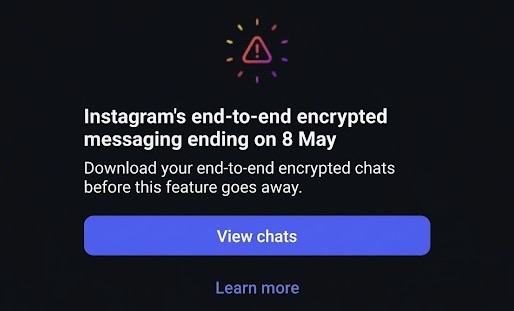
Action required before May 8: If you have any Instagram encrypted chats you want to keep, you need to download them before the deadline. Go to Settings, then Your Activity, then Download Your Information, and select the relevant chats. Instagram has not publicly explained what will happen to existing encrypted chats after May 8. The company has not confirmed whether those conversations will be deleted or converted to standard unencrypted format. Do not assume the messages will simply remain accessible.
After May 8: What Meta Can Do With Your DMs That It Cannot Do Right Now
When encryption ends, Instagram DMs return to the same status as standard unencrypted messages on the platform. Understanding what that means in practice is more important than the abstract privacy framing.
On May 8, Instagram will be able to read your DMs again. Meta is ending support for end-to-end encrypted direct messages, reversing a feature it introduced just two years ago, and reopening the door to automated content scanning, AI-powered moderation, and easier compliance with law enforcement requests.
Content scanning means automated systems can read and analyze message content for policy violations, spam, scams, and illegal material. That has safety implications in both directions: it makes it easier to detect genuinely harmful content, and it also means everything you send through Instagram DMs can be processed by Meta’s systems. In December 2025, Meta said interactions with its Meta AI tools, including those inside private conversations, may be used for targeted ads. Unencrypted DMs bring all message content within scope of those data practices in ways that encrypted messages were not.
Law enforcement access changes significantly. Under E2EE, a valid legal request for message content produces nothing useful from Meta because Meta cannot see it. After May 8, valid legal requests for Instagram DM content can be fulfilled, the same as they can be for standard posts and comments. That is a meaningful change for anyone who has discussed anything sensitive through Instagram’s messaging.
Advertising targeting is the other dimension. With private conversations losing encryption, Meta would be able to show users more ads and ads targeted specifically at certain users. For example, if you tell your friend in DMs that you want to buy a striped shirt, Meta would be very easily able to pick out these keywords and then flood you with ads. This is speculation about behavior Meta has not confirmed, but it is consistent with how the company’s advertising business operates on other data it has access to.
The Take It Down Act: Why the Timing Is Not a Coincidence
Encryption ends on Instagram on May 8. The Take It Down Act takes effect on May 19. The gap between those two dates is eleven days, and the connection between them is not subtle once you understand what the law requires.
The Take It Down Act, which requires platforms to remove non-consensual intimate imagery including AI-generated deepfakes within 48 hours of a valid removal notice, takes effect May 19, just eleven days after Instagram’s encryption cutoff. End-to-end encryption makes compliance tricky. If Meta cannot see what you are sending, it cannot proactively scan for violating content or respond quickly to removal demands. By removing encryption eleven days before the law kicks in, Meta gets ahead of the problem.
Brian Long, CEO of Adaptive Security, said that end-to-end encryption had made that kind of compliance nearly impossible. “If it’s all encrypted and they can’t see the messages, it gets harder for them to actually police those actions. They’re going to be accountable under the law.”
This is the clearest explanation for the timing. Meta is not removing encryption because adoption was low. That was always true and Meta allowed the feature to exist anyway. Meta is removing encryption because keeping it would create legal compliance problems under a law that takes effect weeks from now. The low adoption explanation is the public justification. The Take It Down Act timeline is the operational reason.
TikTok Made the Same Call the Same Week
Meta’s announcement did not happen in isolation. In the same week, TikTok announced it would not introduce end-to-end encryption for direct messages, arguing that the technology could make users less safe by limiting the ability to detect harmful activity.
Together, the moves signal that the era of unconditional privacy promises on social media is over. In the span of two weeks, two of the world’s largest social media platforms signaled they are done treating privacy as an unconditional promise.
TikTok’s position and Meta’s position are different in a specific way worth noting. TikTok never offered E2EE and is declining to add it. Meta offered it, never properly rolled it out, and is now removing it. The outcome for users is similar: neither platform provides end-to-end encrypted messaging. But Meta’s path to that outcome involves explicitly reversing a commitment the company made and a feature it launched, which is a different kind of story than TikTok simply maintaining its existing approach.
The two announcements in the same week, from the two largest social media platforms by active users globally, represent a coordinated if not coordinated signal about where the industry is heading. Encrypted messaging is available on WhatsApp and Signal. On Instagram and TikTok, it will not be. The platforms are dividing along a line between entertainment and social content, where encryption is not offered, and communication utilities, where it is.
What Zuckerberg Said in 2019 and What He Is Doing in 2026
In March 2019, Mark Zuckerberg published a lengthy post titled “A Privacy-Focused Vision for Social Networking.” The central argument was that the future of online communication was private, encrypted, and built around messaging rather than public content feeds. He wrote that people increasingly wanted to communicate in ways that felt more like a private conversation than a public broadcast, and that Meta would build toward that model across Instagram, Messenger, and WhatsApp.
That post is worth reading in the context of what is happening in March 2026. Zuckerberg predicted in his original post that the company would face strong opposition to its plan. But the strength of that opposition still seemed to surprise the company. India, the United Kingdom, and multiple other governments pushed back against encryption with legal pressure and regulatory threats over the intervening years.
What the 2019 post promised and what 2026 delivered are genuinely different things. The vision was encrypted, private messaging as the default across Meta’s platforms. The reality is encrypted messaging on WhatsApp, unencrypted messaging on Instagram after May 8, and a company that buried the opt-in feature it did build for Instagram deeply enough that most users never found it. Whether that represents a failure of execution, a deliberate retreat in the face of regulatory pressure, or simply a change in strategic priorities is not something Meta has explained publicly. What is clear is that the gap between the 2019 vision and the 2026 reality is significant.
Who Gets Hurt Most When Instagram Loses Encryption
The “very few people used it” framing makes it easy to assume this is a minor change affecting a small group of power users. The reality is more specific. The people most affected are not power users who deliberately sought out encryption. They are people who belong to specific groups for whom the absence of encryption creates real risk.
Activists, sex workers, LGBTQ users in authoritarian states, people discussing reproductive rights in post-Dobbs America, and journalists and their sources are among the many groups that benefit from being able to talk in private. And Instagram, crucially, was a place where those groups were likely to meet one another for the first time.
An LGBTQ teenager in a country where being gay is illegal who connected with supportive communities through Instagram DMs was protected by encryption from their government having legal access to those conversations through a subpoena. After May 8 they are not. A journalist who used Instagram to initially reach a source before moving to a more secure channel was protected. After May 8 that initial contact is in Meta’s servers.
These are not edge cases or hypotheticals. They are predictable consequences of removing a privacy protection from a platform that 2 billion people use in wildly different legal and social contexts around the world. The feature was available to only some of those users and rarely used by them, but the people for whom it mattered most were not casual users choosing between convenience and privacy. They were people for whom the choice had actual consequences.
What You Should Do Before May 8
If you have used Instagram’s encrypted chat feature and have conversations you want to preserve, the steps are specific and time-limited.
To download your encrypted chats before May 8: open Instagram, go to your Profile, then Settings and Privacy, then Your Activity, then Download Your Information. Select the format you want (JSON or HTML), choose the date range covering your encrypted conversations, and request the download. Instagram will prepare the file and notify you when it is ready. On older versions of the app you may need to update Instagram first before the download option appears.
For ongoing private messaging going forward, the options outside Instagram are straightforward. WhatsApp, despite being owned by Meta, retains end-to-end encryption by default and Meta has not announced plans to remove it. Signal is the most privacy-focused option among major messaging apps, is fully open-source, and is widely used by journalists, activists, and security researchers for exactly the reasons described above. iMessage provides E2EE between Apple devices. Telegram provides E2EE only in its Secret Chat mode, not in standard chats, which is a distinction worth knowing if you use it.
The practical advice for anyone who was relying on Instagram DMs for anything sensitive: move those conversations to a different platform before May 8 and do not use Instagram DMs for sensitive communication after that date. That is not a dramatic recommendation. It is just an accurate description of what the privacy properties of the platform will be once the change takes effect.
The Bigger Pattern This Is Part Of
Stepping back from the Instagram-specific story, what is happening is larger than one platform removing one feature. Governments across the world have been pushing against encryption for years on the grounds that it creates spaces where illegal content cannot be monitored or removed. The Take It Down Act in the US, the UK Online Safety Act, the European Commission’s proposed Technology Roadmap on encryption, India’s repeated demands that WhatsApp provide access to message content: these represent a sustained multi-year effort by governments to create legal obligations that are structurally incompatible with end-to-end encryption.
Meta’s retreat on Instagram is one visible outcome of that pressure. The company made a commitment to privacy-first messaging in 2019, spent years building toward it, and is now reversing course in response to a legal environment that makes maintaining that commitment increasingly costly. Whether you think that is the right call depends on how you weigh privacy protection against safety enforcement, and that is a genuine values disagreement rather than a question with an obvious answer.
What is not a values disagreement is whether this represents a meaningful change in what Instagram DMs are as a communication channel. It does. Before May 8 they can be end-to-end encrypted for users who opted in. After May 8 they cannot. That is a factual change with factual consequences for how those messages can be accessed, by Meta, by law enforcement, and potentially by others.
The question worth sitting with is a simpler one: in which apps are you having conversations you actually want to keep private? If the answer includes Instagram, you have about seven weeks to rethink that.
Have you been using Instagram’s encrypted DMs? Did you even know the feature existed? Drop your reaction in the comments. The gap between this being a buried help page update and a widely understood policy change is exactly the information asymmetry that makes this kind of coverage worth doing.
References (March 20, 2026):
The Hacker News: “Meta to Shut Down Instagram End-to-End Encrypted Chat Support Starting May 2026”: thehackernews.com
Fortune: “Your Instagram DMs are no longer encrypted: Meta is reversing course on privacy”: fortune.com
Engadget: “Meta is killing end-to-end encryption in Instagram DMs”: engadget.com
Newsweek: “Meta Confirms Major Privacy Change on Instagram”: newsweek.com
Proton Blog: “Instagram drops end-to-end encrypted chats: What it means”: proton.me/blog
Help Net Security: “Meta ditches end-to-end encrypted messaging on Instagram” (March 16, 2026): helpnetsecurity.com
Platformer (Casey Newton): “Why Meta is retreating from encryption”: platformer.news
TechPP: “Instagram DMs Aren’t Private Anymore: Meta Ends E2EE” (March 19, 2026): techpp.com
Instagram official Help Center: end-to-end encrypted messaging support page (meta.com)
Take It Down Act enforcement date (May 19, 2026): US Congress, signed into law 2025
Meta buried the feature so few people could find it.
Then removed it because so few people used it.
On May 8, your Instagram DMs are readable by Meta again.





Leave a Reply