
Sources: Morgan Stanley research report (March 13, 2026) via Fortune; Andrej Karpathy X post and archived chart (March 15, 2026) via Fortune; Anthropic Economic Impact Report (March 2026); Citadel Securities analysis (February 2026); OpenAI GDPVal benchmark results. All unconfirmed claims are labeled as such.
Table of Contents
- Morgan Stanley Just Said What Everyone Was Thinking But Nobody Was Publishing
- GPT-5.4 Already Scores Above Human Experts on Real Economic Tasks
- The Chart an OpenAI Cofounder Built, Posted, Then Deleted
- The Jobs Most Exposed Are Not the Ones You Would Expect
- The Power Grid Cannot Keep Up With What Is Coming
- The Part That Should Actually Scare You: Self-Improvement Loops by 2027
- The Counterargument: Citadel Says the Doomsday Crowd Is Wrong
- This Is All Happening in the Same Week
- What You Should Actually Do With This Information
- Where This Leaves Us
Morgan Stanley Just Said What Everyone Was Thinking But Nobody Was Publishing
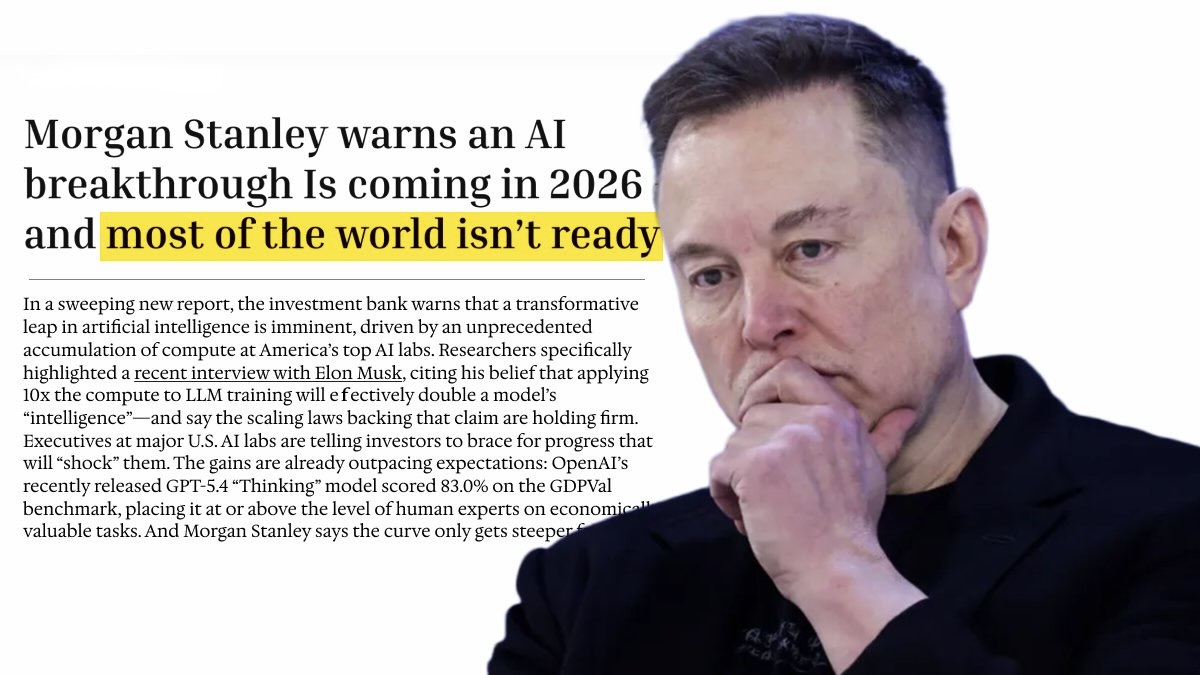
On March 13, three days ago, Morgan Stanley published a research report that most people in finance and tech have now read or heard about. The headline conclusion is blunt: a massive AI breakthrough is coming in the first half of 2026, and most of the world is not ready for it. Not “might be coming.” Not “could potentially arrive.” Coming. In the next few months.
Morgan Stanley is not a hype publication. It is one of the largest investment banks on earth, with analysts whose entire job is to be right about where major trends are heading before the market prices them in. When they publish a sweeping warning about something being imminent, the financial world pays attention. This one landed differently because of the specific claims inside it, not just the headline.
The report cites Elon Musk’s publicly stated belief that applying ten times the compute to large language model training will effectively double a model’s intelligence. That is an extraordinary claim on its own. But Morgan Stanley’s analysts looked at it and said the scaling laws backing that claim are holding firm. Which means the compute is being built, the scaling is working, and the models coming out of that process will be qualitatively different from what exists today. The bank told investors to brace for progress that will “shock” them. OpenAI’s own executives have been saying the same thing in private investor conversations.
All of this is happening while Nvidia’s GTC conference is running this week in San Jose, Meta is reportedly preparing its largest layoff in history, and an OpenAI cofounder published, then deleted, a chart showing which jobs AI is most likely to destroy. It is an unusual week to be paying attention to tech news.
GPT-5.4 Already Scores Above Human Experts on Real Economic Tasks
The Morgan Stanley report does not just make forward-looking predictions. It points to something that has already happened as evidence for where things are going. OpenAI’s GPT-5.4 “Thinking” model, which was released recently, scored 83.0% on something called the GDPVal benchmark.
GDPVal is not a general intelligence test. It specifically measures performance on economically valuable tasks, the kind of work that people get paid to do. The benchmark was designed to assess how capable AI is at tasks that have real economic value, not just at answering trivia or passing standardized tests that were designed for humans. An 83% score on that benchmark places GPT-5.4 at or above the level of human experts on those tasks according to how the benchmark is scored.
That sentence is worth sitting with for a moment. A currently available AI model, not a future one, not a research prototype, something you can access right now, performs at or above human expert level on economically valuable tasks according to one of the most credible AI evaluation frameworks currently in use.
Morgan Stanley’s point in citing this is not that GPT-5.4 has made human workers obsolete today. The gap between performing well on a benchmark and actually replacing the humans who do those jobs is significant, and involves factors like workflow integration, trust, legal accountability, and organizational inertia. The point is that the benchmark performance is ahead of where most people, including most investors and policymakers, thought it would be at this stage. And Morgan Stanley says the curve only gets steeper from here.
Confirmed numbers from the Morgan Stanley report: GPT-5.4 “Thinking” scored 83.0% on the GDPVal benchmark, placing it at or above human expert level on economically valuable tasks. U.S. power shortfall projected at 9 to 18 gigawatts through 2028, a 12 to 25 percent deficit. These are not projections about future models. The benchmark number is from a model available today.
The Chart an OpenAI Cofounder Built, Posted, Then Deleted
The same weekend the Morgan Stanley report went out, something else happened that got significantly less coverage but is arguably more viscerally relevant for most people reading this. Andrej Karpathy, one of the founding members of OpenAI and former head of AI at Tesla, spent a Saturday morning building an analysis tool using Bureau of Labor Statistics occupational data. He described it as a two-hour vibe coding project, meaning he used AI to write most of the code while he directed it. He published the results on his website and posted about it on X.
The chart mapped every major U.S. occupation against an AI exposure score from 0 to 10, with 10 being most exposed. It went viral almost immediately. Within hours it was being shared across finance, tech, and career forums by people who were either alarmed, relieved, or arguing about the methodology. Then Karpathy took it down.
He posted on X Sunday morning saying it had been “wildly misinterpreted” and that he had shared the code for others to explore, not to make definitive claims about job displacement. He did not specify how it was being misinterpreted or what the correct interpretation should be. The chart had already been archived and continued circulating after it was removed from his site.
The data behind it came from the Bureau of Labor Statistics, which is the official U.S. government source for labor market statistics. The AI exposure scores were generated by feeding occupational task descriptions into AI models and asking them to assess how automatable each task is. That methodology has limitations, and Karpathy was right that the results were being interpreted with more certainty than the underlying analysis justified. But the broad pattern the chart showed is consistent with what independent researchers have been finding, which is part of why it spread so quickly.
The Jobs Most Exposed Are Not the Ones You Would Expect
The result that made Karpathy’s chart go viral was not the list of jobs at the top of the exposure scale. It was which economic bracket those jobs fell into. The overall weighted average exposure across all U.S. occupations was 4.9 out of 10. Workers earning under $35,000 per year had an average score of 3.4. Workers earning over $100,000 per year had an average score of 6.7.
The highest-paying jobs in the American economy are, on average, more exposed to AI than the lowest-paying ones. That is the opposite of what most people intuitively expect and the opposite of what previous waves of automation historically delivered. Industrial automation in the twentieth century largely replaced physical, repetitive, lower-wage work. Robots took over factory floors. White-collar knowledge work was considered relatively safe because it required judgment, creativity, and reasoning that machines could not replicate.
The current wave of AI is better at judgment, reasoning, and language than at physical tasks. That inverts the pattern. The jobs that score 9 out of 10 on Karpathy’s chart include software developers, computer programmers, database administrators, data scientists, mathematicians, financial analysts, paralegals, writers, editors, graphic designers, and market researchers. These are among the most educated and highest-paid workers in the country.

At the other end, construction laborers, roofers, painters, janitors, ironworkers, and grounds maintenance workers score 1 out of 10. Home healthcare aides, nursing assistants, dental hygienists, and bartenders score 2. These are jobs that require physical presence, manual dexterity, human-to-human interaction, or navigation of unpredictable real-world environments. Current AI models have essentially no direct competitive advantage over humans in these roles.
This is consistent with what Anthropic published in a separate research report this month. That report found that AI can theoretically cover most tasks in business and finance, management, computer science, math, legal, and office administration. It also found that actual AI adoption in the workforce is still a small fraction of what is theoretically possible, and that the workers most at risk based on their task profiles are older, highly educated, and well paid. The gap between “AI can theoretically do this” and “AI is actually replacing people doing this at scale” is large right now. The question is how long it stays that way.
The Power Grid Cannot Keep Up With What Is Coming
The Morgan Stanley report makes one projection that has nothing to do with model capabilities or job markets and everything to do with physical infrastructure. The bank projects a net U.S. power shortfall of 9 to 18 gigawatts through 2028, representing a 12 to 25 percent deficit in the electricity needed to power the AI infrastructure being built right now.
To put that in context: 9 gigawatts is approximately the output of nine large nuclear power plants. 18 gigawatts is roughly the entire generating capacity of some mid-sized countries. The AI industry is planning to build and operate data centers that require this level of power in a timeframe where the grid cannot realistically be expanded enough to supply it through normal channels.
The response from the companies building this infrastructure is to go around the grid. Bitcoin mining operations are being converted into high-performance computing centers. Natural gas turbines are being deployed directly adjacent to data center sites to provide power without depending on grid capacity. Fuel cells are being deployed at scale. These are stopgap solutions that reflect the severity of the constraint more than they solve it.
Morgan Stanley describes an emerging economic dynamic it calls 15-15-15: 15-year data center leases at 15 percent yields generating 15 dollars per watt in net value creation. Those numbers are extraordinary by any standard measure of commercial real estate and infrastructure investment. They reflect the level of urgency and economic value at stake in the race to deploy AI infrastructure faster than competitors.
The Part That Should Actually Scare You: Self-Improvement Loops by 2027
Most of what is in the Morgan Stanley report is alarming but in a comprehensible way. Models are getting better. That is happening faster than expected. The economic consequences are significant. These are things that can be reasoned about and planned for, at least in principle.
One claim in the report is in a different category. Jimmy Ba, a co-founder of xAI, Elon Musk’s AI company, is quoted suggesting that recursive self-improvement loops could emerge as early as the first half of 2027. Recursive self-improvement is the process by which an AI system becomes capable of improving its own training process, producing a version of itself that is smarter, which then improves the process further, and so on. It is the mechanism that many AI researchers have described as the threshold at which the pace of AI progress becomes fundamentally unpredictable.
Jimmy Ba saying this could happen in the first half of 2027 means fourteen to sixteen months from now. That is not a distant future scenario. That is a claim about something that could happen before most of the students reading this finish their next academic year. Whether you weight this claim as credible speculation, overconfident hype, or a genuine near-term possibility is a judgment call. What is worth noting is that it is coming from a co-founder of one of the companies most likely to be in the room when it happens, and it is appearing in a Morgan Stanley research document rather than a podcast interview or a social media post.
I am not going to tell you what to do with that information. I will say that it is the kind of claim that deserves to be taken seriously rather than dismissed, while also being treated with the epistemic caution that any specific timeline prediction about unprecedented technological thresholds deserves.
The Counterargument: Citadel Says the Doomsday Crowd Is Wrong
It would be irresponsible to lay out the Morgan Stanley report and the Karpathy chart and the self-improvement timeline without also presenting the serious counterargument, because there is one and it comes from a credible source.
Earlier this year, a viral essay from a research firm called Citrini painted a catastrophic picture of an AI-destroyed economy and triggered a minor stock market selloff when it circulated widely. Citadel Securities, one of the largest market makers in the world, responded with a detailed rebuttal that specifically dismantled the doomsday framing using current data rather than projections.
Citadel’s analysis found that Indeed job posting data shows demand for software engineers is actually up 11 percent year over year so far in 2026. That is the category of worker that scores 9 out of 10 on the AI exposure chart. If AI were already eliminating these roles at scale, that number should be going down, not up. Citadel also found that daily use of generative AI for work has been “unexpectedly stable” and presents, in their assessment, “little evidence of any imminent displacement risk.” New business formation in the U.S. is expanding, not contracting. AI data center construction is driving an actual boom in construction and trades hiring.
Citadel made an economic argument worth understanding. If automation expanded as fast as the doomsday scenario assumes, demand for compute would inherently rise, pushing up its marginal cost. At some point the marginal cost of compute rises above the marginal cost of human labor for specific tasks, creating a natural economic boundary where substitution stops making sense. The doomsday scenario assumes this constraint does not exist or does not bind, which Citadel argues is economically incoherent.
The honest position is that both sets of evidence are real. The benchmark scores are real. The job posting data is also real. AI is getting dramatically more capable at tasks that previously required high-skilled knowledge workers. At the same time, the actual labor market impact so far is much smaller than the capability improvements would suggest. Whether the gap between capability and labor market impact closes slowly, suddenly, or not at all is the central uncertainty that nobody, including Morgan Stanley and Citadel, actually knows the answer to.
This Is All Happening in the Same Week
The convergence of these stories in the same few days is not entirely a coincidence, but it is striking enough to be worth noting explicitly. Nvidia’s GTC conference, where Jensen Huang is presenting Vera Rubin as the hardware foundation for the next generation of AI capability, is running right now. Meta is simultaneously reportedly planning to cut 20 percent of its workforce, framing it as an AI efficiency story. Morgan Stanley publishes a report saying a breakthrough is imminent. An OpenAI cofounder builds and then deletes a chart mapping AI’s exposure to every job in the economy. GPT-5.4 scores above human expert level on economically valuable tasks.
These stories are connected. The hardware being announced at GTC is what makes the compute scaling in the Morgan Stanley report possible. The compute scaling is what drives the benchmark improvements in GPT-5.4. The benchmark improvements are what makes the exposure scores in Karpathy’s chart plausible rather than speculative. The exposure scores are part of what is driving the restructuring decisions at Meta and Amazon. All of it traces back to the same underlying dynamic: AI capability is improving faster than almost any prior forecast predicted, and the economic and social consequences of that are starting to show up in measurable ways.
For anyone between 16 and 25 making decisions about what to study, what career to pursue, what skills to invest in, this week’s news is about as directly relevant as any news cycle gets. The information is complicated, contested, and genuinely uncertain in important ways. But pretending it does not exist is not a useful response to it.
What You Should Actually Do With This Information
I want to be careful here because the gap between “AI is getting better at tasks in your field” and “you personally will not have a job in that field” is large and filled with uncertainty. Karpathy’s chart says software developers score 9 out of 10 on AI exposure. Citadel’s data says demand for software engineers is up 11 percent year over year right now. Both of those things are true simultaneously. The chart measures theoretical exposure. The job posting data measures actual current demand. The question of when and whether those two numbers converge is not answered by either data point alone.
What is actionable from all of this is not “do not study computer science because AI will replace programmers.” That conclusion is not supported by the evidence. What is more actionable is understanding which specific tasks within a field are most automatable versus which require judgment, relationships, domain expertise, and accountability that AI cannot currently provide.
A software developer who only writes boilerplate code that could be generated by any capable AI assistant is in a different position from one who architects complex systems, manages technical relationships with customers, makes judgment calls about trade-offs, and understands the business context of what they are building. The job title is the same. The exposure profile is very different. That distinction matters more for career planning than any aggregate exposure score.
The same pattern applies across fields. A financial analyst who runs standard models and produces reports based on templates is in a different position from one who advises clients, interprets ambiguous situations, and is accountable for recommendations in ways that matter legally and professionally. A writer who produces generic SEO content is in a different position from one who has a distinct voice, builds an audience, and creates content that is valuable specifically because a person with a particular perspective made it.
The pattern is consistent: the parts of any knowledge work job that can be reduced to a repeatable process on well-defined inputs are increasingly automatable. The parts that require judgment on ambiguous information, relationships, accountability, and creative synthesis of the kind that is valuable because of who is doing it are much more resistant to automation. Orienting your skills toward the second category is a reasonable response to the evidence, regardless of what specific field you are in.
Where This Leaves Us
Morgan Stanley saying a breakthrough is imminent in the first half of 2026 is a significant claim from a significant institution. GPT-5.4 scoring above human expert level on economically valuable tasks is a real benchmark result from a model available today. Karpathy’s chart showing the highest-paid workers are the most exposed is consistent with what independent research has been finding. The power grid cannot keep up with the infrastructure being built. A co-founder of xAI is talking about self-improvement loops emerging in fourteen months.
None of this means the doomsday scenario is correct. Citadel’s counterargument using actual labor market data is serious and should not be dismissed. The gap between AI capability and AI-driven labor market disruption has been larger and more persistent than most predictions have forecast. It is possible that gap persists for longer than Morgan Stanley’s report implies. It is also possible that it closes much faster than Citadel’s current data suggests. Nobody actually knows, and anyone who claims certainty in either direction is overconfident.
What seems clear is that this is not a slow-moving trend that can be safely ignored until it becomes more obvious. The benchmark improvements are real. The infrastructure investment is real. The companies building this stuff are hiring for it, spending hundreds of billions on it, and restructuring their workforces around it right now. Whether you are a student, a developer, a writer, a financial analyst, or any other kind of knowledge worker, understanding what is happening and why is more useful than either dismissing it or panicking about it.
What does this change for you specifically? What field are you in or planning to enter, and how does the exposure pattern in Karpathy’s data map to what you were planning to do? Drop it in the comments and I will give you a specific take on which parts of that path look resilient and which look worth thinking harder about.
References (March 16, 2026):
Morgan Stanley AI breakthrough report, Fortune (March 13, 2026): fortune.com
Andrej Karpathy AI labor market analysis and X post, Fortune (March 15, 2026): fortune.com
Archived Karpathy chart (BLS occupational data): web.archive.org
Anthropic labor market impact report (March 2026): cdn.sanity.io (Anthropic)
Citadel Securities response to Citrini doomsday essay, Fortune (February 2026): fortune.com
GPT-5.4 GDPVal benchmark score (83.0%): OpenAI, cited in Morgan Stanley report
Jimmy Ba (xAI co-founder) on recursive self-improvement: Morgan Stanley report citation
Indeed software engineer demand data (up 11% YoY, 2026): Citadel Securities analysis
The AI that is going to change your career is not the one coming in ten years.
It is the one that already scored above human expert level last month.



Leave a Reply