Table of Contents
- The Word Collins English Dictionary Chose for 2025
- What Vibe Coding Actually Is, Without the Hype
- Where the Term Came From and What Karpathy Actually Said
- Traditional Coding vs Vibe Coding: The Real Difference
- 41% of All Global Code Is Now AI-Generated. The Numbers Are Wild.
- The Six Tools You Need to Know in 2026
- What You Can Actually Build Without Knowing How to Code
- The Honest Problems Nobody Puts in the Tutorial
- What Vibe Coding Means If You Are Learning to Code Right Now
- The Skill That Actually Matters: Becoming an Orchestrator
- Should You Start Vibe Coding? An Honest Answer
The Word Collins English Dictionary Chose for 2025
Every year Collins English Dictionary picks one word that defined the cultural moment. In 2025 they picked vibe coding. Not AI. Not AGI. Not some policy term or geopolitical phrase. A programming concept that started as a single tweet from a researcher in February 2025 and spread fast enough in twelve months to become the word of the year. Merriam-Webster listed it as “slang and trending” in March 2025, just weeks after the term was coined. By the end of 2025 it was everywhere from developer forums to mainstream news to corporate earnings calls.
If you have not caught up yet, that is what this article is for. Vibe coding is genuinely one of the most important shifts in how software gets built, and it matters whether you are a developer, a student thinking about a career in tech, or someone who has an app idea but never learned to code. The implications are different for each group, and this article covers all three honestly.
What Vibe Coding Actually Is, Without the Hype
Vibe coding is a software development practice where you describe what you want to build in plain language and an AI generates the code for you. Instead of writing every function, variable, and loop yourself, you tell the AI what you need and iterate on its output through conversation. The “vibe” part refers to focusing on the intent, the outcome, the feel of what you are building, rather than the implementation details of how to write it.
The definition that programmer Simon Willison gave is the clearest line between vibe coding and regular AI-assisted coding: “If an LLM wrote every line of your code, but you have reviewed, tested, and understood it all, that is not vibe coding in my book. That is using an LLM as a typing assistant.” Vibe coding specifically involves accepting AI-generated code without reviewing it line by line, trusting the results, and using follow-up prompts to fix what does not work. You are not reading the code the AI writes. You are testing whether it does what you asked.
That distinction matters for understanding both why vibe coding is powerful and why it creates specific risks. More on both shortly.
Where the Term Came From and What Karpathy Actually Said
Andrej Karpathy is one of the founding members of OpenAI and the former head of AI at Tesla. In February 2025, he posted on X describing a new way he had been working: “There is a new kind of coding I call vibe coding, where you fully give in to the vibes, embrace exponentials, and forget that the code even exists.” He described just seeing things, saying things, running things, and copy-pasting things, and said it mostly worked.
Karpathy was not describing a professional methodology. He was describing a personal experiment, a way of building throwaway projects quickly by removing his own friction with the implementation layer. He explicitly said this was best suited for rapid ideation and what he called “throwaway weekend projects.” The concept of forgetting that the code even exists was a deliberately extreme framing for what happens when you trust the AI completely and focus only on outcomes.
The internet took that framing and ran with it, which is both how the term spread so fast and why some experienced developers pushed back against it. Andrew Ng, the AI pioneer, specifically took issue with the term, saying it misleads people into assuming software engineers just “go with the vibes” rather than applying genuine technical judgment. His concern was valid in the sense that professional vibe coding in 2026 looks considerably more structured and disciplined than Karpathy’s original framing suggested. But the name stuck and the practice exploded regardless of anyone’s concerns about the terminology.
Traditional Coding vs Vibe Coding: The Real Difference
In traditional programming, you write code at the instruction level. You specify exactly what the computer should do, step by step, in the syntax of a particular language. You think about data types, control flow, error handling, memory management, and performance. The gap between “I want this to work” and “here is the code that makes it work” is something you bridge yourself.
Vibe coding moves you up the abstraction stack. Instead of writing instructions, you write intentions. “Build me a login form that validates email format and shows an error message if the password is shorter than eight characters” is a vibe coding prompt. The AI generates the HTML, CSS, JavaScript, and validation logic. You look at the result in the browser, see that the error message styling does not match the rest of the page, and tell the AI to fix that. You never touched the code directly.
Google Cloud’s current documentation describes vibe coding as operating on two levels: the low-level iterative loop of refining code through conversation, and the high-level lifecycle of taking an idea from concept to deployed application. The full cycle looks like this: you describe the entire application in a high-level prompt, the AI generates an initial version including UI, backend logic, and file structure, you test it, you use follow-up prompts to add features or change behavior, and eventually you deploy it. Google calls the deployment part “vibe deploying,” where launching to a production environment takes a single click rather than a DevOps setup process.
The shift in what the developer does is significant. In traditional coding you focus on implementation. In vibe coding you focus on specification, testing, and judgment about whether what got built is actually what you wanted.
41% of All Global Code Is Now AI-Generated. The Numbers Are Wild.
The adoption statistics for vibe coding and AI-assisted development are large enough that they warrant stating directly rather than just referencing them.
| Statistic | Number | Source |
|---|---|---|
| US developers using AI coding tools daily | 92% | Second Talent 2026 survey |
| Global developers using AI tools at least weekly | 82% | Second Talent 2026 survey |
| Share of all global code that is AI-generated | 41% (256 billion lines in 2024) | Second Talent 2026 survey |
| Fortune 500 companies using at least one vibe coding platform | 87% | Second Talent 2026 survey |
| Developers reporting increased productivity with vibe coding | 74% | Second Talent 2026 survey |
| Google code that is AI-generated (per Sundar Pichai) | 25%+ | Alphabet Q1 2025 earnings call |
| Microsoft code written by AI (per Satya Nadella) | 30% | Microsoft public statement |
| Developers who spent more time debugging AI code than writing it manually (at least once) | 63% | Second Talent 2026 survey |
The last number in that table deserves as much attention as the ones above it. 63 percent of developers have at some point spent more time debugging AI-generated code than they would have spent writing the code themselves. That is the other side of the productivity story that tends to get left out of vibe coding enthusiasm. The AI generates fast. It does not always generate correctly. And debugging code you did not write, in a style you did not choose, using patterns you may not recognize, can be slower than starting from scratch would have been.
One more number worth knowing: A December 2025 analysis by CodeRabbit of 470 open-source GitHub pull requests found that AI co-authored code had approximately 1.7 times more major issues than human-written code. Specifically: misconfigurations were 75% more common in AI code, and security vulnerabilities were 2.74 times more frequent. The productivity gain is real. So is the quality gap. Both matter.
The Six Tools You Need to Know in 2026
The vibe coding tool landscape has consolidated somewhat since early 2025, when new platforms were appearing every week. The tools that have proven durable divide roughly into two categories: tools for people who already code and want to go faster, and tools for people who have never written code and want to build something anyway.
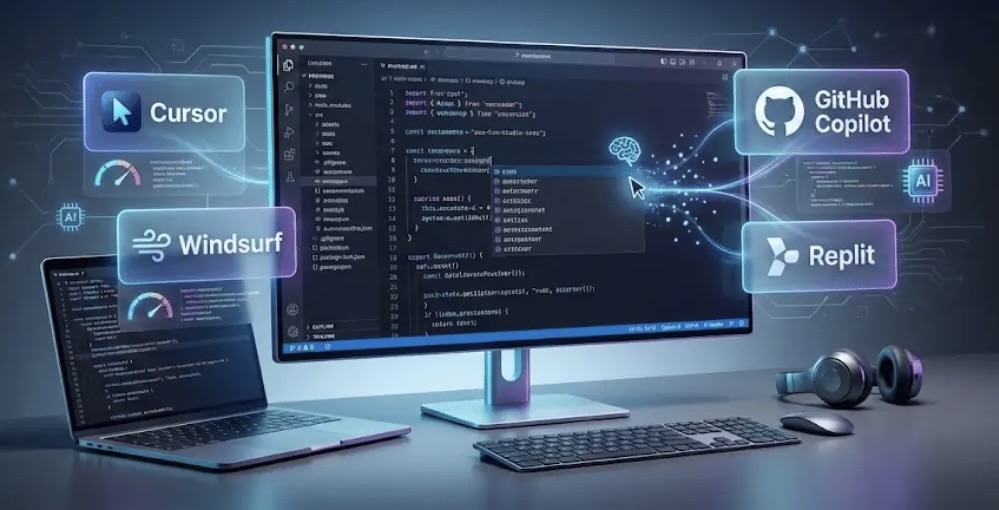
Cursor is the primary tool for developers who already know how to code. It is a VS Code fork with deeply integrated AI agent capabilities. You describe what you want to build or change, the agent reads your codebase, writes the code across multiple files, and shows you a diff to review. As discussed in CyberDevHub’s earlier article on cloud agents, Cursor’s own engineering team now has 35 percent of their production pull requests created by agents. For developers who want to stay in a familiar IDE environment while dramatically increasing their output speed, Cursor is the current standard.
Replit Agent is the best option for going from a natural language description to a working, deployed application in the browser. You describe what you want to build, Replit generates the full application including front end and back end, and deploys it to a live URL you can share immediately. No local setup, no DevOps, no configuration. For students, non-developers, and anyone building prototypes or MVPs, the friction of going from idea to running app is lower on Replit than anywhere else.
Lovable has established itself as the go-to tool specifically for building web applications through conversation. The output quality for modern, attractive UIs is consistently strong, and the ability to iterate through prompts without touching code has made it popular with founders and product people who want to build functional demos before involving a development team.
Bolt.new from StackBlitz is a browser-based full-stack development environment with strong AI generation capabilities. It handles both front-end and back-end code generation, supports deployment directly from the browser, and is particularly good at generating applications with database integrations. Many developers use it in combination with Cursor, generating initial scaffolding in Bolt and then refining in their local environment.
GitHub Copilot is the most widely deployed AI coding assistant by raw user count, integrated directly into VS Code, JetBrains, Neovim, and other major editors. It operates more at the autocomplete and suggestion level than the full agent level, which makes it more suitable as a productivity layer on top of traditional coding than as a pure vibe coding tool. For organizations that want AI assistance without the more radical workflow changes of agent-based tools, Copilot is the standard entry point.
Google AI Studio and Firebase Studio are Google’s vibe coding platforms, updated as recently as March 20, 2026. AI Studio is designed for experimentation and prototyping, while Firebase Studio targets full application development with deployment to Google Cloud infrastructure. Google’s native integration means apps built here can access Google services directly, and the “vibe deploying” feature handles production deployment in a single click.
What You Can Actually Build Without Knowing How to Code
One of the things I find most interesting about vibe coding is that the list of things you can realistically build without prior coding knowledge has changed dramatically in the last twelve months. Not theoretically build with perfect prompts under ideal conditions. Actually build, deploy, and use.
Business tools are the most common category: customer management dashboards, invoice generators, internal data trackers, employee onboarding tools, and reporting systems that would previously have required a developer and several weeks of work. Founders building their first product, freelancers building tools for clients, and operations teams that need software their company will not budget to build professionally are all using vibe coding for exactly these use cases.
Personal tools are the second category where the low barrier matters most: personal finance trackers, habit monitoring apps, custom note-taking systems, portfolio websites, and automation scripts for repetitive tasks. These are the kinds of projects where the cost of hiring a developer made them impractical to build, but the investment of learning to code from scratch felt disproportionate for something you only need to work for yourself.
SaaS prototypes are where the economic implications get significant. In 2021, building an MVP to validate a business idea took three months and roughly $50,000. In 2026, a founder who understands the problem domain and can write clear specifications can build, test, and deploy a functional SaaS prototype over a long weekend for the cost of an API subscription. That change in the economic threshold for building software has implications for who starts software businesses, who can compete with incumbents, and how quickly new ideas get validated.
Linus Torvalds, creator of the Linux kernel, noted in January 2026 that the Python visualizer tool in his AudioNoise project had been “basically written by vibe coding.” If the person who wrote the Linux kernel is using vibe coding for some of his work, the legitimacy question has been answered.
The Honest Problems Nobody Puts in the Tutorial
Every vibe coding tutorial shows you the part where the AI generates exactly what you asked for in thirty seconds and it works perfectly. Most tutorials skip the part where it does not, which is a meaningful fraction of the actual experience.
The hallucination loop is the first real problem. AI models sometimes generate code that looks completely correct but contains subtle bugs or logical errors that only surface under specific conditions. When you are not reading the code yourself, these bugs are harder to catch than they would be if you had written the code, because you do not have the mental model of how it works that would make the error visible. The term “shadow bug” describes code that appears to function correctly but contains structural security vulnerabilities or edge case failures that emerge in production.
Technical debt accumulates fast when you do not understand what you have built. If the AI generates a database schema, an authentication system, and an API layer for you, and you cannot read the code those are built on, you cannot easily modify them later without generating potentially conflicting code on top of what is already there. September 2025 reporting from Fast Company described experienced engineers dealing with “development hell” when inheriting or working with vibe-coded codebases, where the lack of coherent structure made iterative development significantly slower than starting clean would have been.
Security vulnerabilities are the problem with the most serious consequences. The CodeRabbit analysis finding security vulnerabilities 2.74 times more common in AI-generated code than human-written code is not a reason to never use vibe coding. It is a reason to take security review seriously even when you are not writing the code yourself. An application that handles user data, processes payments, or provides access to sensitive information built entirely through vibe coding without security review is a meaningful risk regardless of how well the feature functionality works.
Junior developers face a specific version of this problem. The survey finding that 40 percent of junior developers admit deploying AI-generated code they do not fully understand is alarming not because the code will necessarily be wrong, but because understanding why code works is how developers build the judgment that makes them better at everything else. Vibe coding without also investing in understanding what the AI is generating can accelerate shipping while slowing down skill development.
What Vibe Coding Means If You Are Learning to Code Right Now
This is the section that matters most for the CyberDevHub audience specifically, because a significant fraction of you are either in computer science programs, thinking about learning to code, or early in development careers. The question of how vibe coding changes the calculus for learning is one that the industry has strong opinions about and not a clean consensus on.
The honest answer is that vibe coding is a productivity tool, not a learning tool. Using it to build things faster once you understand the fundamentals is the right use. Using it as a substitute for learning the fundamentals is a bet that the fundamentals will never matter, which the evidence does not support.
Senior developers with more than ten years of experience report 81 percent productivity gains from vibe coding. Mid-level developers with three to ten years of experience see 51 percent faster task completion but spend more time reviewing generated code. Junior developers with fewer than three years of experience see mixed results. Those numbers describe a pattern where the productivity benefit scales with the depth of existing knowledge. The senior developer using vibe coding can quickly evaluate whether the AI’s output is correct because they already know what correct looks like. The junior developer who cannot evaluate correctness is not gaining the same thing from the same tool.
The practical advice from engineers and researchers who have thought carefully about this: learn to read and write code first. Understand how web applications work, how databases work, how APIs work, how authentication works. Build small projects from scratch even when vibe coding tools would let you skip that. The understanding you build through that process is what makes you a skilled orchestrator of AI tools rather than someone who can generate code without understanding what they have built. One is a career. The other is a skill that may hit a ceiling sooner than you want.
The Skill That Actually Matters: Becoming an Orchestrator
The most useful frame for thinking about vibe coding in 2026 comes from a description that has been circulating in developer communities: the shift from being an implementer to being an orchestrator. An implementer writes code. An orchestrator directs AI systems to write code and provides the judgment about whether the output is correct, safe, and worth keeping.
Three skills define what makes a good orchestrator, and they are different from the skills that made a good traditional developer. The first is context architecture, which means structuring the information you provide to an AI so clearly and completely that it cannot generate something incorrect because it does not have enough context to guess wrong. Instead of “tricking” a model with clever prompts, you learn to give it schemas, constraints, and documentation that make the desired output the only reasonable output.
The second is the ability to evaluate output quality without reading every line. A good orchestrator can look at a generated codebase and assess whether the architecture makes sense, whether the security model is reasonable, and whether the approach will scale, without necessarily reading every function. That is a skill built on real coding experience, not a shortcut around it.
The third is product judgment: the ability to define what you want to build and why it matters with enough clarity that the specification itself is correct before any code is written. In a vibe coding workflow, a bad specification generates fast and deploys fast and fails for reasons that trace back to the original prompt being wrong, not the AI generating incorrectly. The human judgment about what to build is the constraint that was always the most important one. Vibe coding just makes it more visible.
Should You Start Vibe Coding? An Honest Answer
For developers who already know how to code: yes, start now if you have not already. The productivity difference between developers using AI tools effectively and those who are not is real and growing. Cursor or GitHub Copilot as a starting point, whichever fits your current workflow better, gets you into the productivity benefit without requiring a complete rethink of how you work. The key is to stay engaged with what the AI is generating rather than just accepting output without judgment.
For people who want to build something but have never coded: try it. Replit, Lovable, or Bolt give you a low-friction path to see whether you can build the thing you have in mind through natural language. Be realistic about complexity: a straightforward CRUD application or informational website is genuinely achievable. An application with complex business logic, custom integrations, and high security requirements is going to require either significant iteration and technical knowledge or bringing in a developer at some point. Vibe coding lowers the entry point without eliminating the complexity that exists in genuinely hard problems.
For students learning to code: use vibe coding as a productivity tool, not a learning substitute. Let the AI help you move faster on projects you already understand. Use it to explore how something might be implemented and then read and understand what it generated before using it. The engineers who will be most valuable in five years are the ones who both understand the fundamentals and can direct AI tools effectively. Skipping the fundamentals to reach the AI tools faster is the long way around.
Vibe coding is the Collins Dictionary Word of the Year for a reason. It represents a genuine shift in how software gets built, who can build it, and what skills matter most in the process. The people who understand both its power and its limitations are the ones who will use it best.
Have you tried vibe coding? What did you build, and what broke? Drop it in the comments. The real stories of what actually works and what falls apart are more useful than any benchmark comparison.
References (March 21, 2026):
Wikipedia: Vibe coding (full history, Karpathy origin, Torvalds use, CodeRabbit analysis, academic criticism): en.wikipedia.org/wiki/Vibe_coding
Google Cloud: “Vibe Coding Explained: Tools and Guides” (updated March 20, 2026): cloud.google.com/discover/what-is-vibe-coding
Second Talent: “Top Vibe Coding Statistics and Trends 2026” (92% daily use, 41% AI-generated code, 87% Fortune 500, 74% productivity gain, 63% debugging stat): secondtalent.com
Sitepoint Vibe Coding Guide 2026 (AI-first development methodology, orchestrator framework, tool comparisons): sitepoint.com
Verdict: “Vibe coding will become mainstream in 2026” (GlobalData predictions, popular tools list): verdict.co.uk
Emergent.sh: “What is Vibe Coding? A Complete Guide for Beginners in 2026”: emergent.sh
CodeRabbit analysis: 470 GitHub PRs, AI code has 1.7x more major issues, 2.74x more security vulnerabilities (December 2025)
Collins English Dictionary Word of the Year 2025: vibe coding
Merriam-Webster: “slang and trending” listing for vibe coding, March 2025
Sundar Pichai (25%+ of Google code AI-generated): Alphabet Q1 2025 earnings call
Satya Nadella (30% of Microsoft code written by AI): Microsoft public statement 2025
You no longer need to know how to code to build software.
You do still need to know what you are building and whether it actually works.





Leave a Reply