
Table of Contents
- You’ve Been Watched (And You Liked It)
- What Is Collaborative Filtering?
- Content-Based Filtering: The New Show Problem
- Matrix Factorization: The Real Engine
- How the Full Pipeline Actually Works
- The Thumbnail You See Is Not the Thumbnail I See
- Why Netflix Recommendations Feel Like a Trap
- What This Means for You Right Now
- Final Verdict
You’ve Been Watched (And You Liked It)
It’s 11 PM. You open Netflix to “just check what’s on.” Forty minutes later you’re three episodes deep into a show you had never heard of before tonight.
That wasn’t random. That was a machine learning system that spent months learning exactly what you’d click on, when you’d keep watching, and when you’d bail. It knew before you did.
I’m going to break down exactly how Netflix pulls that off: the real engineering behind it, explained so it actually makes sense. No PhD required.
Spoiler: It’s not one algorithm. It’s a whole pipeline of them working together, and the further you get into this post, the more unsettled (and honestly impressed) you’ll feel.
What Is Collaborative Filtering?
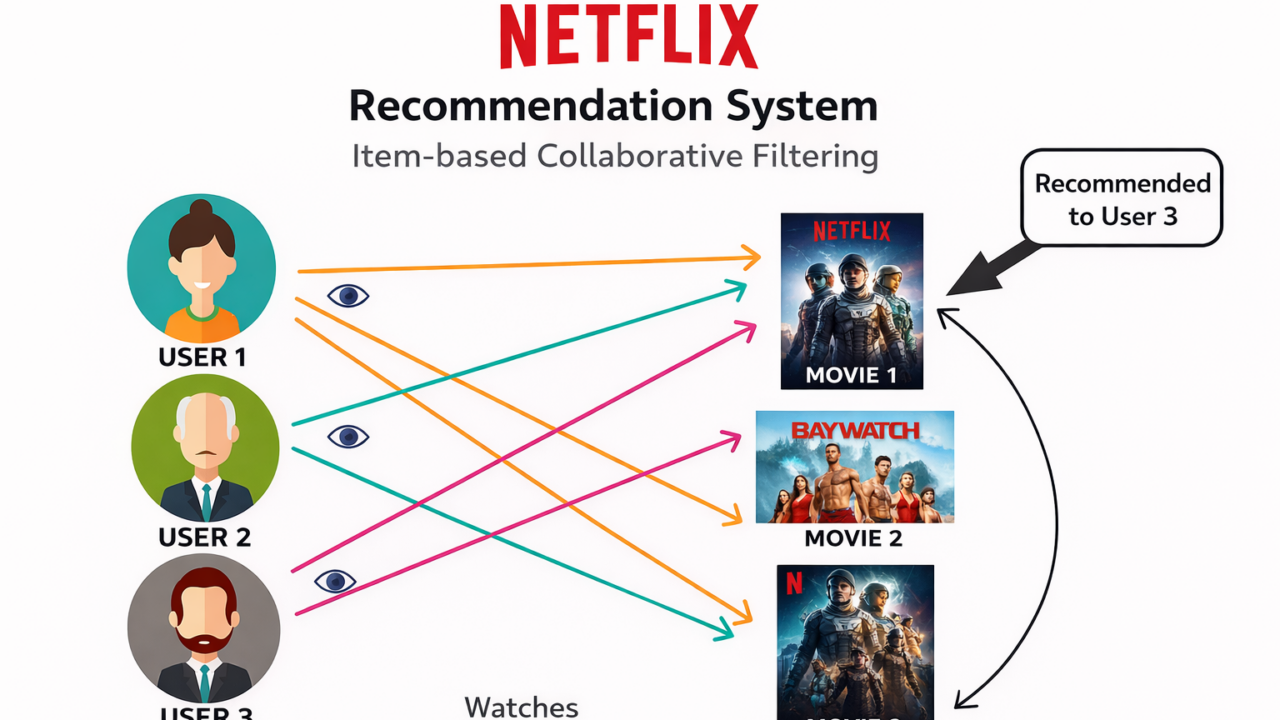
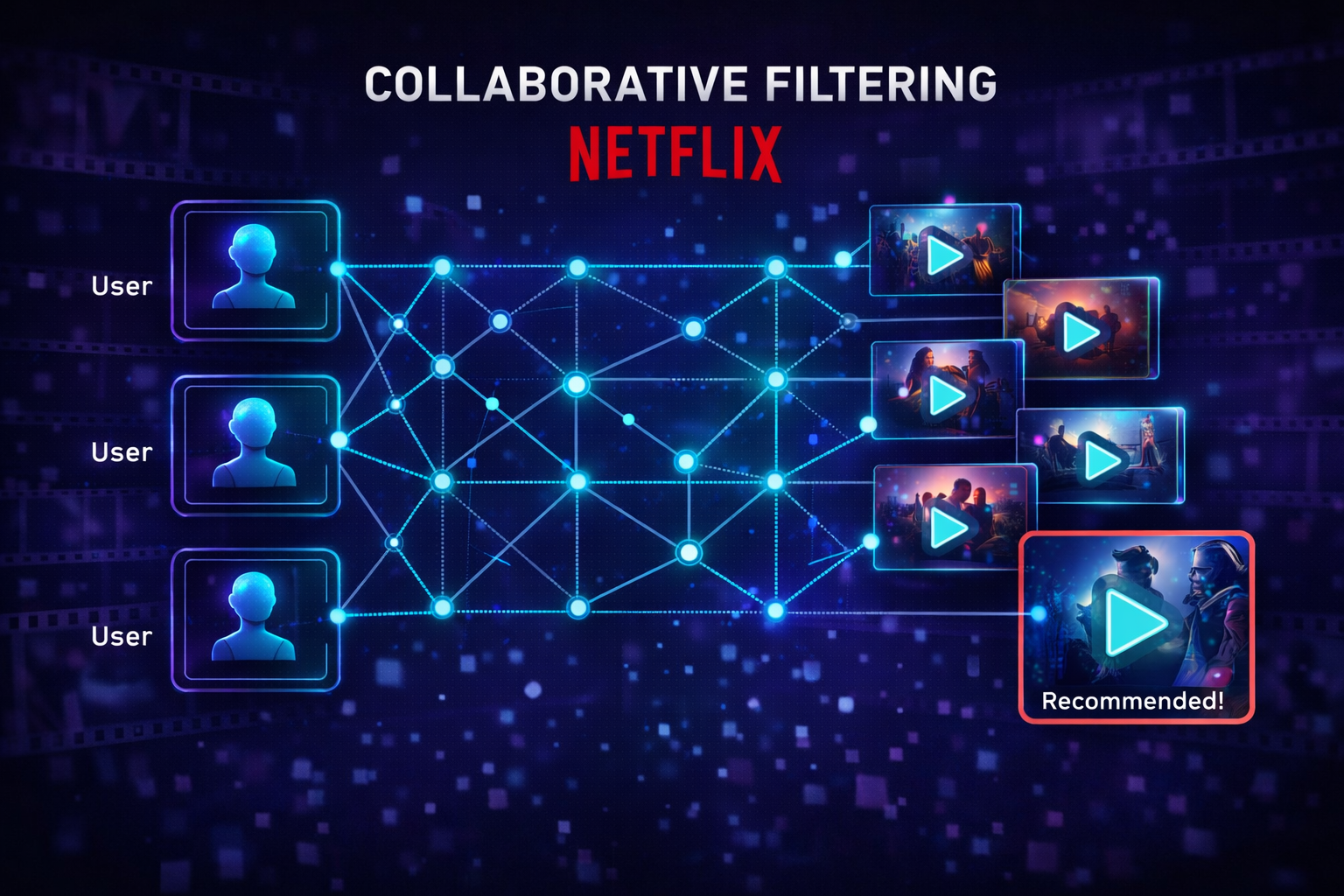
This is where it all starts. Collaborative filtering is the idea that people with similar watch histories tend to like similar things. Netflix finds users who behave like you, then recommends what they watched that you haven’t seen yet.
Think of it like your school cafeteria. You sit with the same group every day. One of them starts obsessing over a new show. You check it out. You love it. Netflix just automated that conversation across 300 million people simultaneously.
Here’s a stripped-down version of the logic:
- User A watched Stranger Things, Dark, and Severance
- User B watched Stranger Things, Dark, and Mindhunter
- They share two shows, so Netflix figures they have similar taste
- Mindhunter gets recommended to User A
In practice it’s way more complex than that. Netflix doesn’t just track what you finished. It tracks how long you watched before stopping, whether you rewound a scene, what time of day you opened the app, and what device you were on. Every single one of those is a signal that goes into your profile.
Content-Based Filtering: The New Show Problem
Collaborative filtering has one big weakness. It only works if a show already has viewer data behind it. What happens when Netflix drops something brand new that nobody has watched yet?
That’s where content-based filtering steps in. Instead of looking at who watched what, it looks at what the content actually is.
Netflix tags every title with incredibly detailed metadata: genre, tone, pacing, director, cast, themes, narrative structure, mood. If you’ve been watching a lot of slow-burn psychological thrillers and a new show gets those same tags, Netflix can push it to you on day one before a single other person has clicked play.
| Filtering Type | How It Works | Best For | Weakness |
|---|---|---|---|
| Collaborative | Finds users with similar watch history | Proven titles with lots of data | Useless for brand new content |
| Content-Based | Matches on tags, genre, tone, cast | New releases, niche content | Misses cross-genre surprises |
| Combined (Netflix) | Both methods running together | Everything, all the time | Computationally expensive |
Here’s the wild part. Netflix reportedly has a tagging system called altgenres that goes way beyond “action” or “comedy.” We’re talking micro-genres like “dark Scandinavian psychological crime drama with an unreliable narrator.” Thousands of these tags, assigned manually and through automated analysis, create a fingerprint for every single title on the platform.
Matrix Factorization: The Real Engine
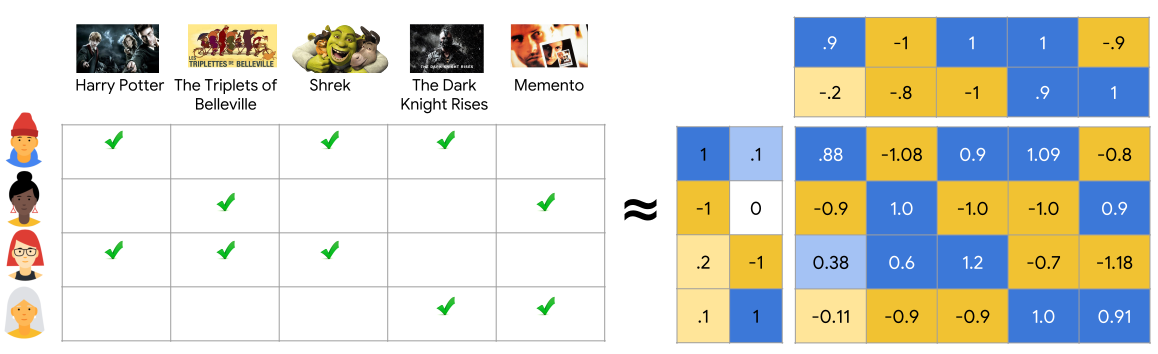
Both of those methods run on top of a deeper technique called matrix factorization and this is where things get genuinely interesting.
The basic idea: Netflix converts every user into a list of numbers that represents their taste, and converts every show into a list of numbers that represents what kind of viewer tends to enjoy it. When those two lists are mathematically close to each other, that becomes a recommendation.
You don’t need to understand the linear algebra. The intuition is enough. Your entire Netflix personality gets boiled down to a vector: a fingerprint of numbers: and the system spends every second scanning millions of titles to find the ones whose fingerprint best matches yours.
This is also why Netflix recommendations update over time. You binge a crime documentary series one weekend and suddenly your vector shifts. The model noticed. Your homepage next week looks different.
How the Full Pipeline Actually Works
Here’s the full flow from the moment you open the app to the moment you see your homepage:
- Data Collection: Everything you’ve ever done on Netflix gets logged. Watches, pauses, searches, scroll behavior, ratings, device, time of day.
- User Embedding: All of that gets compressed into your taste vector. A numerical snapshot of who you are as a viewer right now.
- Content Embedding: Every title has its own vector built from viewer behavior patterns and content metadata.
- Similarity Matching: The system scans the library and finds titles whose vector is closest to yours. These are your raw candidates.
- Ranking Model: A separate model takes those candidates and ranks them based on predicted engagement, novelty, and business factors like what Netflix wants to promote.
- Homepage Assembly: Your rows get built. The titles, their order, their row labels, and even the thumbnail artwork all get optimized for you specifically.
The whole thing runs in milliseconds every time you open the app. You see a personalized homepage. Someone else in your house opens the same account and sees something different based on their viewing profile within the same account.
The Thumbnail You See Is Not the Thumbnail I See
This is the detail that gets people. Netflix doesn’t just recommend different shows to different people. It shows different artwork for the same show depending on who’s looking at it.
If you tend to watch movies featuring a particular actor, Netflix will show you a thumbnail with that actor prominently placed, even if they’re a supporting character. If your watch history skews toward darker, moodier content, you’ll see the darker, more intense version of a poster. Netflix A/B tests thousands of thumbnail variants and uses your behavior to figure out which one is most likely to get you to click.
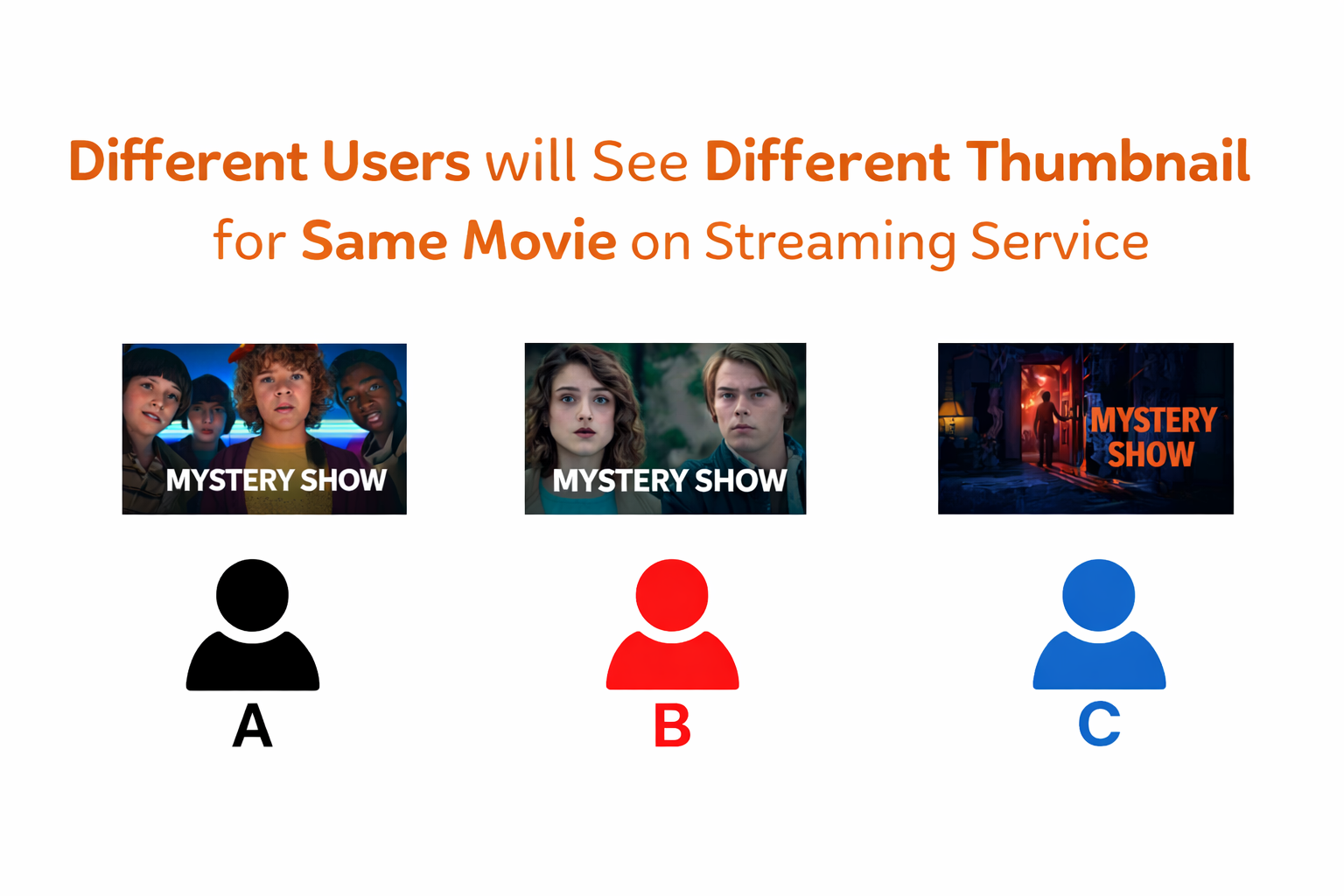
The recommendation system isn’t just deciding what to show you. It’s also figuring out exactly how to present it so you’re most likely to watch. Every pixel of your homepage is being optimized. Most people have no idea this is happening.
Why Netflix Recommendations Feel Like a Trap
Here’s the part that makes some people uncomfortable once they really think about it.
Netflix’s system is not designed to show you the best content. It’s designed to maximize engagement. Those two things sound similar but they are not the same.
- Finish a show? Positive signal. The model learns to serve more of that.
- Binge an entire season in one night? Strong positive signal.
- Leave autoplay running while you fall asleep? The model counts those as watches too.
- Drop a show at episode 2? Negative signal. That type of content gets deprioritized for you.
The algorithm isn’t malicious. It’s doing exactly what it was built to do. But it’s optimizing for watch time, not for you actually enjoying or getting value from what you watch. This is one of the genuinely hard open problems in AI right now: how do you build a system that recommends what users truly want, rather than just what they’ll compulsively click on?
Netflix and every major platform are still working on that one. For now, the trap is real.
What This Means for You Right Now
Use Grok 3 as your Netflix research assistant if you:
Wait, wrong article. Let’s try that again.
Start paying attention to what you’re teaching the algorithm if you:
- Notice your homepage has gotten weirdly narrow and repetitive
- Want Netflix to surface better quality content for you
- Care about not getting stuck in a recommendation loop
Keep watching however you want if you:
- Are genuinely happy with what Netflix serves you
- Mostly use it as background noise anyway
- Have your own shows queued up and don’t rely on the homepage
The practical takeaway: every click, every watch, every pause is training your profile. If you want better recommendations, be intentional about what you tell the algorithm you like. Use ratings. Finish things you love. Stop watching things you don’t after five minutes instead of half-heartedly finishing them.
And if you’re a student interested in AI or data science, this system is your cheat code for understanding production ML. Collaborative filtering, content-based models, matrix factorization, A/B testing, behavioral feedback loops: Netflix runs all of them at scale, in real time, for over 300 million people. That’s not a textbook exercise. That’s the actual industry standard.
Final Verdict
Netflix’s recommendation system is genuinely one of the most impressive pieces of applied machine learning in the world: and it’s running on your scroll habits right now.
The scary part isn’t that it tracks you. It’s that it’s usually right. And understanding how it works is the first step to actually being in control of what it shows you.
My honest recommendation: Next time you open Netflix, look at your homepage differently. Every row, every thumbnail, every title order was computed for you specifically. Then ask yourself whether that list reflects what you actually want to watch, or just what the algorithm has learned to put in front of you.
Drop your thoughts in the comments. Do you think recommendation algorithms make streaming better or worse overall? I’d genuinely like to know where people land on that.
You’ve been training an AI model for years without knowing it.
Question is: are you happy with what it learned?





Leave a Reply