
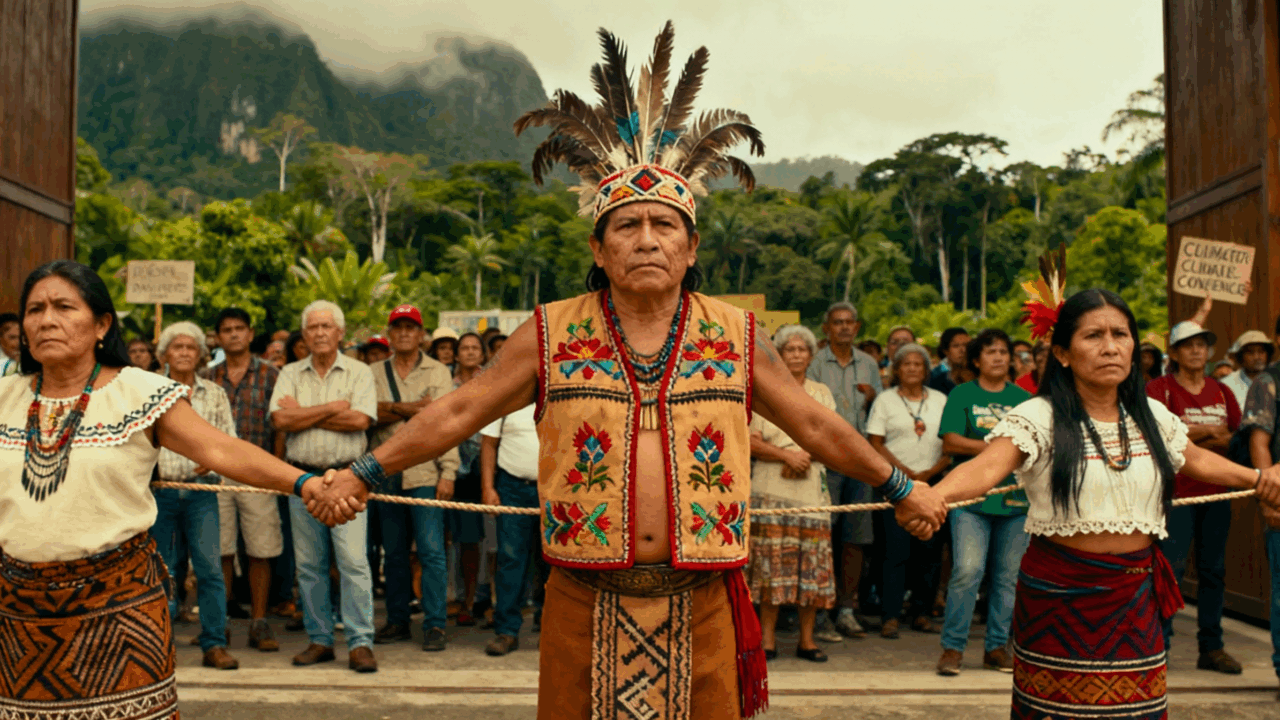
The 2025 United Nations Climate Change Conference (COP30) in Belém, Brazil—meant to showcase the world’s commitment to environmental action—became the stage for powerful Indigenous resistance on November 14, when approximately 100 Munduruku protesters formed a human chain, blocking the main entrance to the climate talks for 90 minutes. Their dramatic action highlighted a fundamental contradiction: while world leaders gathered under the Amazon’s canopy to negotiate climate solutions, the Brazilian government was simultaneously advancing infrastructure projects that threaten the very territories Indigenous peoples have protected for generations.
The Core Conflict: Climate Justice vs. Development Agendas
The blockade wasn’t a spontaneous act of frustration—it was a calculated message with specific, non-negotiable demands. The Munduruku Indigenous group, coordinated by the Ipereg Ayu Movement, came to COP30 demanding that President Luiz Inácio Lula da Silva address what they see as betrayal of Indigenous rights in favor of agribusiness expansion.
At the center of their grievances lies Decree 12,600/2025, which established the National Waterways Plan and designated the Tapajós, Madeira, and Tocantins rivers as priority cargo transportation routes. The Munduruku view this policy as a direct threat to their livelihood, describing it as turning rivers into “soy highways.” The decree will accelerate dredging operations that destroy sacred rock formations, expand private port operations, and contaminate waterways with pesticides.
Beyond the decree, protesters demanded the cancellation of the Ferrogrão railway—a long-planned agribusiness corridor designed to link Mato Grosso to Pará. According to Indigenous leaders, this 170-kilometer rail project could increase grain transport along the Tapajós River sixfold by 2049, intensifying deforestation, soy cultivation, and river contamination.
A Larger Movement for Territorial Recognition
The Munduruku blockade was not isolated. It reflected the broader demand from Indigenous communities across the Amazon and beyond for meaningful inclusion in climate negotiations. Before the entrance blockade, another group of Indigenous protesters had forced their way into a COP30 building on November 11, demanding that deforestation for summit-related construction be halted.
More significantly, over 200 boats carrying approximately 5,000 Indigenous, riverine, and quilombola leaders sailed to Belém in what became known as the “Answer Caravan.” This historic flotilla, representing representatives from 60 countries, was a direct response to what participants describe as “false climate solutions” that ignore Indigenous stewardship.
Chief Raoni Metuktire, a prominent Indigenous leader, articulated the stakes clearly: “The forest lives because we are here. If they remove the people, the forest will die with them. We don’t want oil drilling or the Ferrogrão.”
Why Indigenous Voices Matter: The Climate-to-Deforestation Connection
The urgency behind these protests stems from hard data: between 2015 and 2020, tropical deforestation rates increased dramatically, reaching alarming levels in 2024 when wildfires led to global deforestation rising by 80% to 6.7 million hectares—the worst level since measurements began.
Indigenous territories, by contrast, have proven to be some of the world’s most effective carbon sinks. Research consistently shows that recognizing forest areas as communal Indigenous lands is a cost-effective way to protect nature, as communities make decisions to prevent development projects like oil drilling and mining. Yet despite Brazil’s 1988 constitution mandating Indigenous territory recognition, “40 years later we’re still fighting to have our rights secured,” according to Chief Ninawa of Brazil’s Amazon Huni Kuin people.
COP30’s Contradictions: Pledges Without Protection
The irony running through COP30 is profound. While the conference promoted itself as empowering Indigenous peoples, with over 900 Indigenous participants (up from 300 at COP29 in Baku), the physical infrastructure of the event itself required clearing 13 kilometers of Amazon rainforest. This contradiction did not go unnoticed by protesters, who carried signs reading “Our forest, our lives” and “No greenwashing on stolen land.”
Meanwhile, Brazil announced the Intergovernmental Land Tenure Pledge Commitment, under which nine tropical forest nations committed to formally recognize land rights across 80 million hectares by 2030. Brazil itself pledged 59 million hectares—more than a third of the global commitment. The Netherlands, Norway, and the United Kingdom pledged $1.8 billion to support land tenure rights implementation.
Yet even these pledges face implementation challenges. Recent efforts by Indonesia to recognize 1.4 million hectares have been slower than anticipated, and advocates warn that “to recognize a territory means to give forests the freedom to keep living along with those who belong to them,” not merely to sign documents.
The Institutional Response: Recognition Without Radical Change
When confronted with the blockade, COP30 officials didn’t immediately capitulate—but they did acknowledge the legitimacy of the demands. COP30 Executive Director Ana Toni declared the demonstrations “legitimate” and confirmed that the government was listening. Protesters were directed to meet with Brazil’s Minister of Indigenous Peoples, Sônia Guajajara, and Minister of Environment and Climate Change, Marina Silva.
In a moment capturing the human dimension of the conference, the COP30 negotiations president engaged in extensive talks with protesters that lasted 90 minutes, even holding a protester’s baby during discussions.
However, activists argue that meetings with ministers fall short of the systemic change required. Toya Manchineri, Coordinator of the Coordination of Indigenous Organizations of the Brazilian Amazon (Coiab), emphasized that real transformation would require Indigenous leaders to be included as official negotiators within Brazil’s delegation—not merely as observers or external stakeholders.
The Bigger Picture: Forest Defense as Climate Action
Indigenous advocates framing territorial protection as climate policy—not merely social justice—represents a fundamental reframing of climate solutions. The “We Are the Answer” campaign, which has reached Indigenous communities worldwide, places demarcation and territorial protection at the center of climate emergency response. This messaging reframes Indigenous activism from defensive posturing to proactive climate leadership.
President Lula acknowledged this at the opening plenary, urging the international community to “recognize the role of Indigenous territories and traditional communities in mitigation efforts.” Yet as Toya Manchineri noted, the challenge now is persuading all participating countries to include this measure in the final COP30 agreement.
What Happens Next: From Protest to Policy
The Munduruku blockade and the broader Indigenous mobilization at COP30 will likely achieve some incremental wins—additional funding pledges, stronger language about Indigenous participation, perhaps commitments to accelerate demarcation processes. But the fundamental tension remains unresolved: can climate diplomacy, held within the structures of global capitalism and nation-state governance, truly prioritize Indigenous territorial rights over extractive industries and agribusiness expansion?
The “Answer Caravan” participants carried a simple message to the negotiators inside the Blue Zone: “The people are the answer. The forest lives because they do.” Whether COP30 delegates will authentically incorporate that answer into binding commitments remains to be seen.